

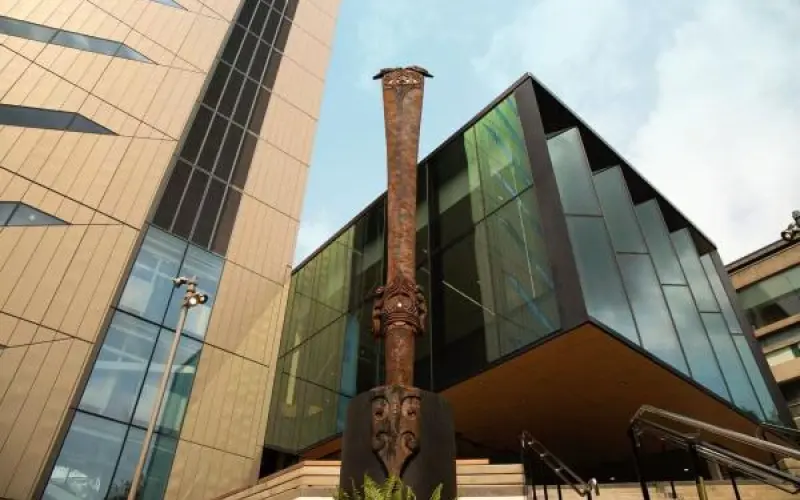


In 2016, the University of Auckland commissioned the design of a 12-storey, 32,000 m2 education building that could support engineering teaching and research for years to come. The structure-led design and build team comprised Jasmax (architectural design), StructureDesign (structural design), Beca (building services) and Hawkins (head contractor). The building, Te Herenga Mātāi Pūkaha, was completed in December 2019 and opened in time for Semester 1 2020.
A signature project on the University of Auckland’s city campus, the building incorporates several design innovations. Civil engineering PhD students Deao Xing and Li Xu, funded by the MBIE Endeavour Programme led by HERA, researched the project, and their findings will inform future research in design automation and smart construction, setting a benchmark for future builds.
The building
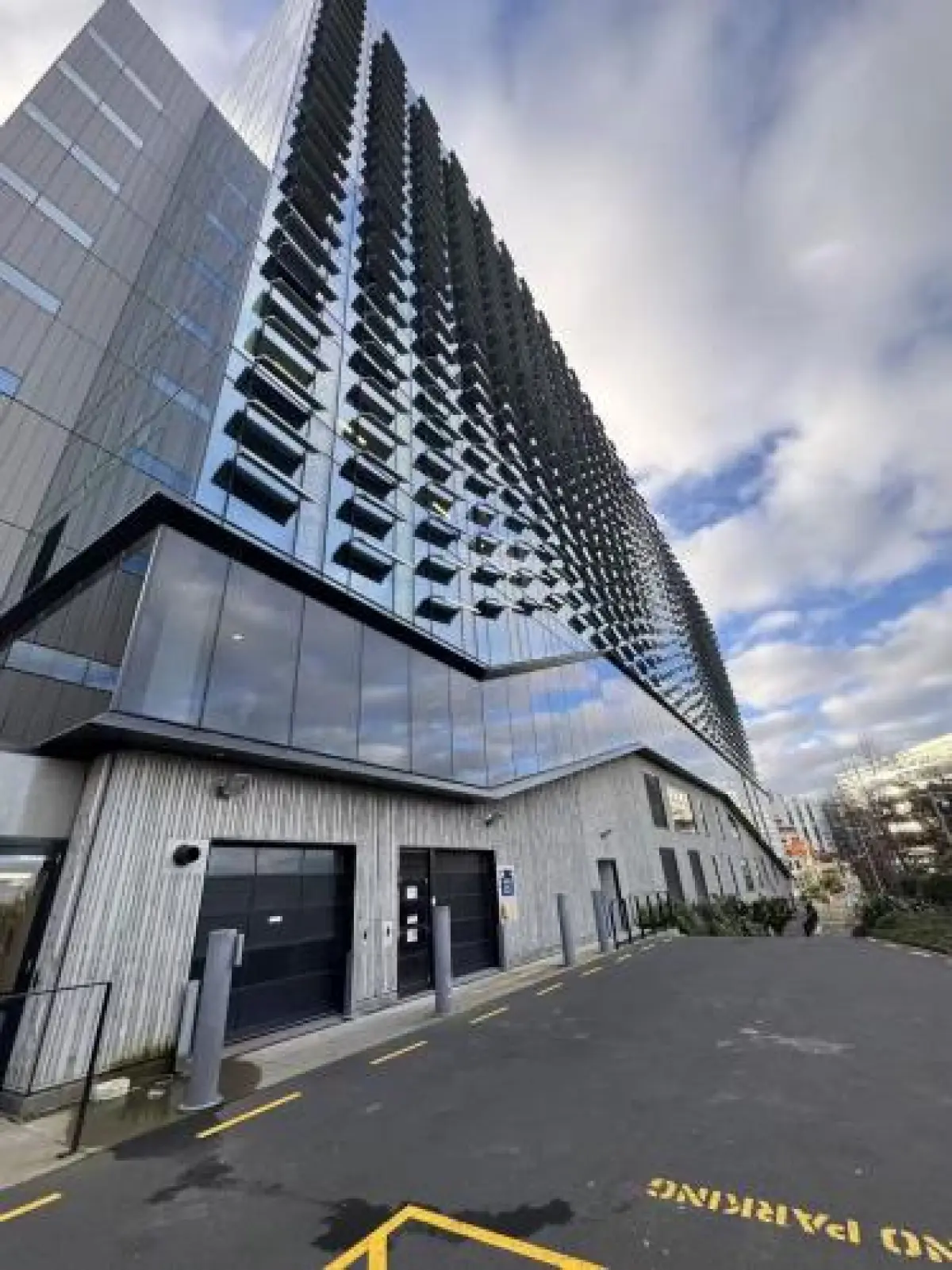
A landscaped forecourt with a central pou whenua greets people entering the building. Te Herenga Mātai Pūkaha appears as two halves. On the east face, 486 aluminium sunshades are set from horizontal to 30°. On the west face, a solid street frontage is overlaid with large hanging sheets of glass in red, orange and yellow.
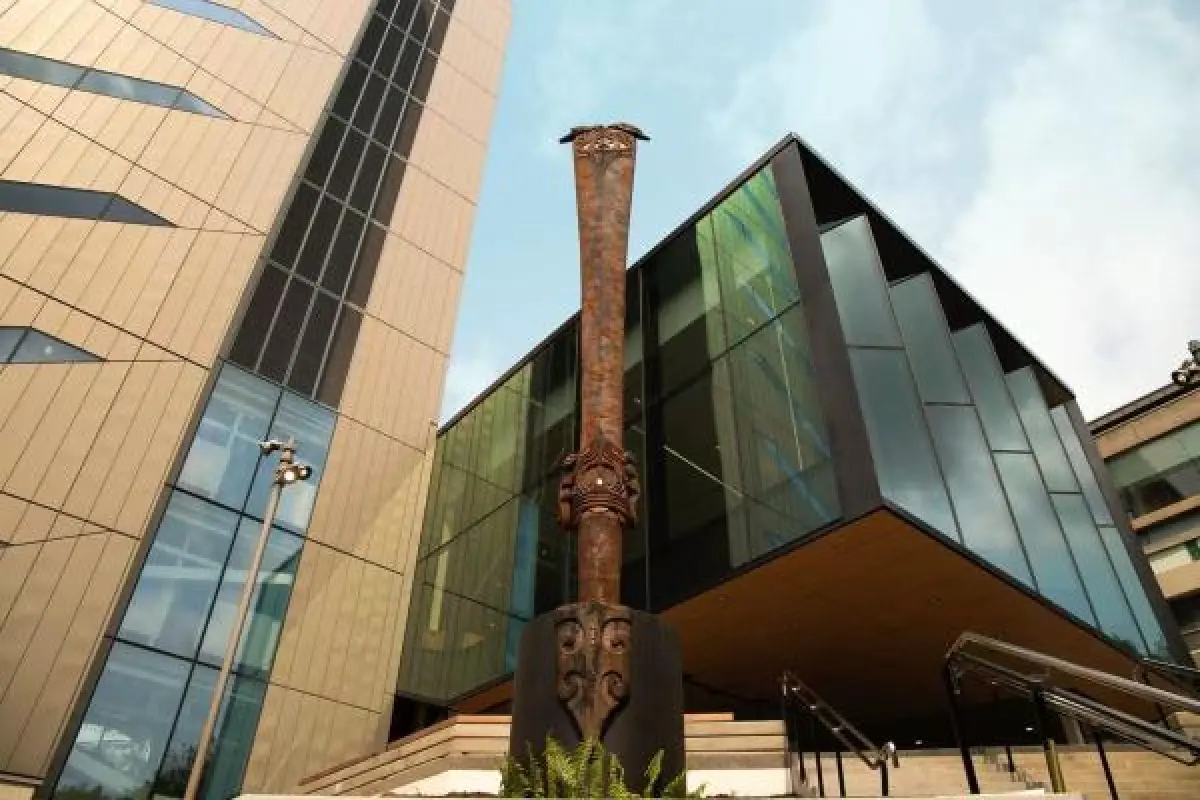
A three-storey glazed atrium links the new building to the existing 1970s engineering building. Stairs lead to the heart of the building – a cathedral-like cube cantilevered over the entrance – while a winding staircase anchors the core.
Many internal systems are intentionally exposed, reflecting the client’s aim to make the engineering visible. Glazed ceilings and walls reveal buckling-restrained braces, structural frames, service cavities, and plant and communication zones, helping communicate the building’s structural logic and seismic-resilience systems. The building integrates sustainability measures with precision prefabrication and digitally fabricated structural components.
Features include:
- seismic considerations – designed for an 80-year life to a seismic standard allowing business continuity post-earthquake.
- capacity – 12 storeys, 114 m long, 42 m wide, 32,000 m2 interior, a capacity for 4,000 students and staff.
- steel – 3,300 tonnes of structural steel, 40 km of pipes, 12 km of ducts, and 8 km of secondary steel beams.
- rooms – 26 teaching laboratories, 28 specialised research laboratories, more than 800 rooms and unallocated space for unforeseen future needs.
- cost – $224 million.
- build duration – 30 months.
- workforce – 400–500 workers on site at any one time.
Long-span spaces adaptable to future needs
As the client’s key requirement was for a large, open, flexible space that could be multi-functional and adaptable to future needs without major structural intervention, the design featured 13 m long-span structures and minimal columns. While timber was considered it could not at that time meet the required spans and structural performance. In 2016/17, low-carbon design was not a major focus, so steel was selected for its ability to deliver the necessary spans and stiffness. Recyclability was recognised as a long-term benefit rather than a key driver of design.
Composite metal deck systems enabled lightweight floors, reducing seismic mass while maintaining stiffness. Secondary steel beams were optimised to within 1–2% of their structural limits using computer-controlled cutting and welding. This advanced fabrication also reduced material use, saving $1.5 m.
The building was divided vertically and horizontally to optimise use and energy efficiency, with teaching on levels 1–5 and research laboratories on levels 6–11. Each floor comprises two independent zones so one side can be modified or serviced without disrupting the other.
Seismic resilience
Buckling-restrained braced frames (BRBFs) met the goals of protecting people during an event and allowing rapid return to service afterwards. These act as a structural fuse, concentrating seismic damage within replaceable bracing elements while preserving the surrounding frame. High-precision manufactured pinned connections are visible to reinforce engineering on display.
The foundation incorporates enhanced stiffness to avoid permanent damage. A Level 1 concrete base forms both a retaining structure and a stiff foundation platform, addressing the sloping site. Shear walls on the lower-level perimeter provide additional lateral stability.
Resilience also depends on protecting non-structural elements, especially services, with detailed bracing and restraint systems.
Embedding cultural identity and user requirements
Architects Jasmax used a questionnaire-based approach to gather user requirements, while cultural narratives and commissioned artworks (including the pou whenua) helped express institutional identity and cultural values.
Design features were considered to support user comfort and cultural appropriateness. Coordination among architects, structural engineers, building services engineers, façade specialists and fire engineers was critical, supported by BIM modelling to align spatial, structural and services requirements.
Delivering services for complex user needs
With more than fifty specialist research laboratories plus extensive teaching and collaboration space, the building required complex services. BIM was critical to services design. A building management system continuously monitors comfort and safety and provides local visual indicators of critical safety matters, such as the presence of gas.
Passive and active fire protection systems were developed through multidisciplinary coordination, including fire suppression and smoke exhaust based on airflow modelling in large spaces and laboratory conditions. Façade performance was analysed in relation to HVAC requirements.
Balancing performance, compliance, cost and sustainability
Prefabrication balanced cost efficiency with the precision required for structural performance. From Level 2 upwards, primary structural steelwork was fabricated off site using computer-controlled cutting and welding, and secondary steelwork was digitally fabricated. Beams exceeding 13 m were produced in Aotearoa as they could not be transported in standard shipping containers.
Digital modelling, including BIM-based workflows, supported precision, coordination and cost control. Contractor and client engagement and flexibility was needed to accommodate changes and fluctuating costs. Quantity surveyors and contractors worked collaboratively to identify efficient, appropriate or available alternatives.
Although carbon performance was not a primary driver in 2016/17, tools such as life-cycle assessment and Environmental Product Declarations were recognised as useful for considering sustainability.
Constructability
Constructability was seen as crucial from the outset, reflecting the complexity of erecting a large steel frame on a constrained campus site. Site activities were planned to deliver architectural and structural work safely and efficiently without disrupting traffic on nearby roads.
The design and construction teams divided the building into three longitudinal zones. An erection sequence linked framing modules, composite floors and temporary works. Deep fabricated beams with service penetrations, concrete-filled hollow steel columns and buckling-restrained braced frames were detailed to remain stable at intermediate stages, enabling a skip-floor strategy where steel advanced several levels ahead of concrete pours. Temporary bracing members and welded erection cleats were integrated into the permanent steelwork to control deflection and stability, supporting multiple work fronts once a second tower crane was introduced.
BRBF connection drilling tolerances (around 2 mm) were managed through digital modelling and early engagement with fabricators, allowing jigs, tooling and welding procedures to be set up off site. Preloading materials onto completed floor plates and coordinating façade and services zones so installation could proceed safely beneath ongoing structural work addressed limited laydown space.
Research findings
- Good building design depends on early collaboration between client and contractors.
- Seismic resilience relies on non-structural components and building services as much as structural systems, requiring integrated design and detailing.
- Sustainability outcomes are constrained by market economics and supply-chain maturity as much as by technical feasibility – particularly for timber.
- Compliance frameworks shape design decisions as both regulatory requirements and market drivers.
- Cultural identity, user experience and constructability are core components of design quality and positive project outcomes.
Lessons learned
The project shows that complex, high-rise steel structures on constrained sites require meticulous planning and flexible execution. Upfront planning should set clear objectives – divide the building into manageable zones and adopt sequences enabling parallel work faces. Digital tools can improve coordination and visualisation, but simple visual aids – for example, annotated elevation – can be just as effective for communicating the programme.
Plan labour to maintain skills continuity as new crews are introduced and monitor progress closely so delays can be mitigated through resequencing, overtime or resource reallocation. Logistics are critical when access is limited – deliveries must be booked, materials must arrive just in time, and crane operations must be coordinated across trades. Skip-floor construction, with integrated temporary bracing, helped accelerate steel erection and create work fronts for follow-on trades – supporting completion before the 2020 academic year.
Digital engineering tools such as BIM and model-based visualisations support these approaches by improving coordination and communicating sequence. AI and other data-driven tools may gradually assist with tasks such as progress tracking and scenario testing but should complement the work of experienced planners and engineers.