



Queries have come to the BRANZ Helpline about the flooring options in E3/AS1 for household wet areas such as kitchens, bathrooms, laundries and toilet facilities.
Flooring options for wet areas in E1/AS1
Flooring options for wet areas are covered in E3/AS1 Amendment 7, section 3.0 Watersplash. The floor lining materials are listed in 3.1.1 Floors. It covers linings and finishes to floors that satisfy the performance criteria for impervious and easily cleaned surfaces in areas containing sanitary fixtures and sanitary appliances.
There are just three floor finish options given:
- Integrally waterproof sheet material (e.g. PVC – polyvinylchloride) with sealed joints and sealed or coved at edges.
- Ceramic or stone tiles having 6% maximum water absorption, waterproof grouted joints, and bedded with an adhesive specified by the tile manufacturer as being suitable for the tiles, substrate material and the environment of use. Tiles must be laid on a continuous impervious substrate or membrane.
- A slab-on-grade concrete floor with a steel trowel or polished finish.
No timber or timber-based products
The three floor finish options included in the current E3/AS1 do not include any timber or timber-based products at all. However, there are timber flooring options that are durable and robust and able to be installed to a suitable level of specification. The Acceptable Solutions makes provision for this in a comment:
“Other floor finishes may also be capable of satisfying the performance for impervious and easily cleaned, if installed in a manner that prevents gaps or cracks within the finish and at any parts of its perimeter that are exposed to watersplash, and/or if the surface is sealed with a suitable durable coating. However such other finishes are outside the scope of this Acceptable Solution.”
Timber systems in wet areas
Not all timber overlay and clip-type systems are designed for use in these wet areas, but several are, and with suitable specific high-quality surface sealer coatings, they can remain durable and impervious.
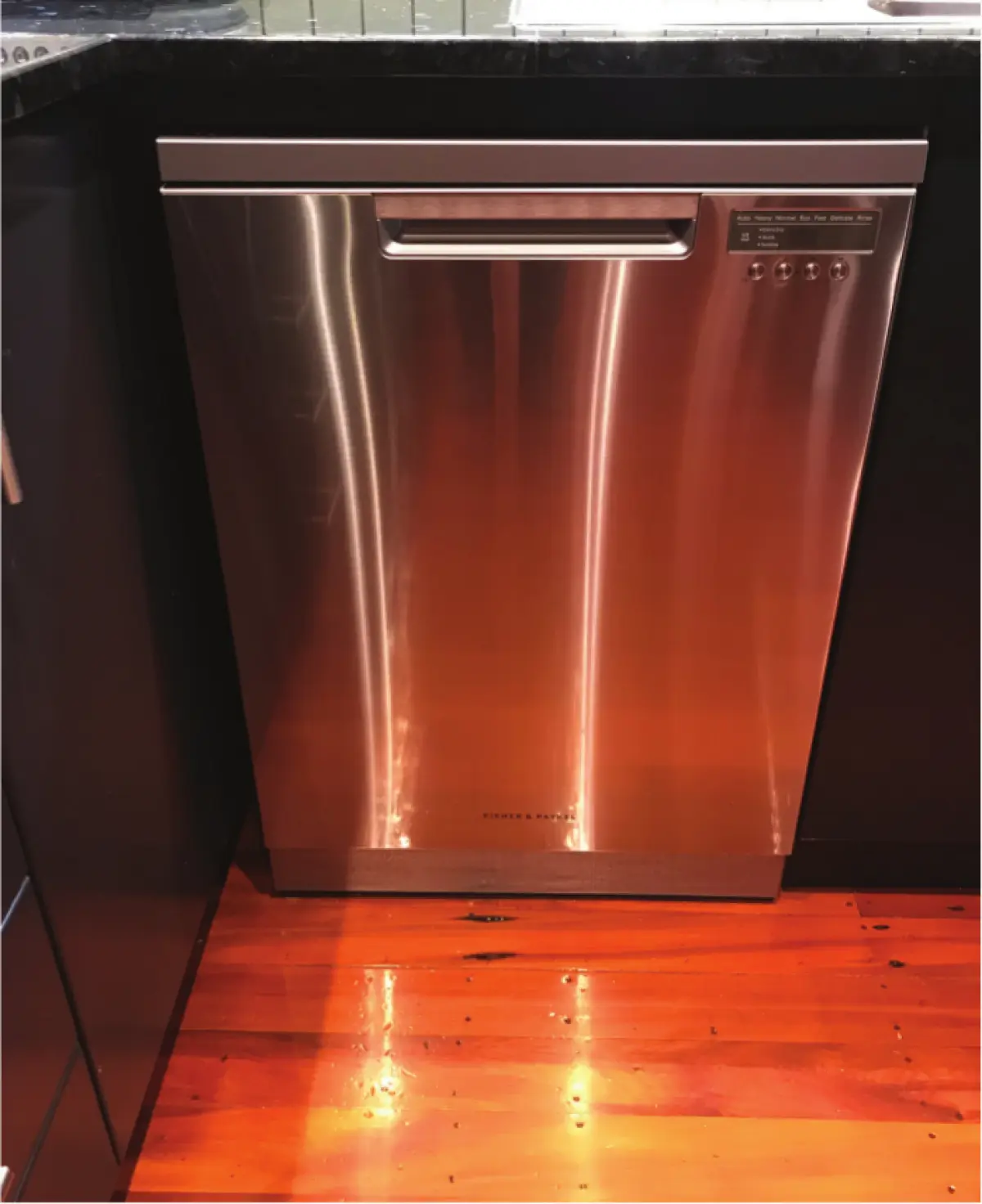
Solid timber tongue and groove (T&G) floors, when installed correctly using suitable materials and sealer coatings, have traditionally performed well in domestic wet areas such as kitchens. Figure 1 shows the dishwasher installed nearly 25 years ago in my own kitchen on a Mātai T&G floor.
The floor has survived a couple of small floods with no issues, but we did apply four coats of sports-floor polyurethane to the entire room – including under all kitchen joinery – and lapped up the wall junctions.
Our bathrooms upstairs, on identical polyurethane-coated Mātai floorboards, have also had no problems over 25 years although they do have the safeguard of their original CP floor wastes installed during initial construction in 1936.
Our architectural practice regularly specifies new overlay and suspended timber T&G floors – often in new homes, but also to marry into existing, original native timber T&G floors. In service areas where they might get a splash of water, they are timeless and extremely durable when done well, but that does mean using the best materials and experienced professional installers.
Alternative Solution is a good option
If you want a particular wet area floor other than PVC, tiles or polished concrete, it will have to be designed and consented as an Alternative Solution to demonstrate compliance.
This is not difficult for robust systems and where the risk of failure is lower, such as standalone housing. Take as an example my wet area Mātai T&G floor. If we design and specify to best practice and can illustrate good history of use of that flooring system, it should be able to satisfy a building consent authority.
Think of an Alternative Solution as freeing you from the constraints of Acceptable Solutions. You are no longer limited to just three wet area flooring options – you have an infinite number to choose from.
Maybe you will struggle to smuggle a shagpile carpet in the bathroom through building consent. However, this shouldn’t deter you from presenting quality alternatives that you can justify as fit for purpose in your building consent applications.