

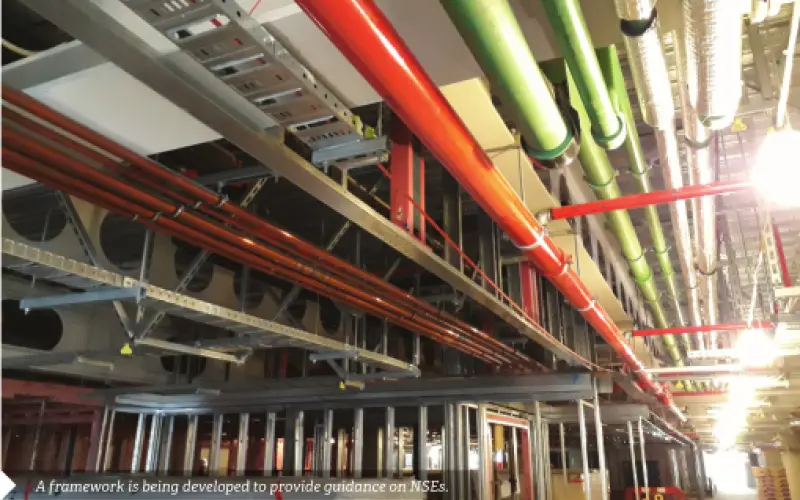


Buildings are more than just beams and columns. Objects like ceilings, partitions and building services – non-structural elements (NSEs) – are essential for a building to work the way we want it to. Although these elements don’t hold the building up, they still have a big impact on the overall damage and downtime of a building after an earthquake.
The seismic design of NSEs is inconsistent
When it comes to preparing for earthquakes, NSEs haven’t received as much focus as the main structure. Recent studies have revealed significant inconsistencies in Aotearoa New Zealand’s building industry about how these components are designed and specified to achieve the earthquake performance requirements of the Building Code. Issues also exist in ensuring designs are installed in line with what was specified. Too often, a lack of coordination can result in clashes during construction that result in delays and extra expenses for the whole project.
Lack of guidance
One of the major problems identified is a lack of guidance around how NSEs should achieve the earthquake performance requirements of the Building Code. This results in inconsistency in areas such as the performance criteria and the design requirements adopted in different projects by designers and contractors.
There is also uncertainty around what performance needs to be achieved by different components in the same facility. For example, does a fuel pump that feeds a generator need to be seismically certified to the same level as the generator that it provides fuel to?
This inconsistency and lack of guidance means that building owners and tenants are left unsure about what they need to do to comply with earthquake safety standards. They also don’t know what steps to take if they want to make their buildings even more resilient to earthquakes.
BRANZ-funded project
To address these issues, the Building Innovation Partnership has initiated a BRANZ-funded project to develop a framework to provide guidance on performance characterisation, classification and specification, and quality assurance of NSEs. Together, the whole process – from performance characterisation of a component to its classification or specification for easy selection and then finally ensuring correct installation through quality assurance protocols – is referred to as seismic qualification.
Performance characterisation
Industry guidance will be developed on the performance expectations for NSEs at varying performance levels and associated seismic hazard. For example, the guideline will document the probable damage that a component or system may sustain while still meeting its functional requirements. The damage state will be one of the following:
- The component must remain undamaged or sustain minor damage only to a level that would not require repair (SLS1).
- The component can sustain a described level of damage that would not impair the function of the component or the function of the building but may need some level of repair (SLS2).
- The component can sustain damage up to the maximum, which will still comply with the life safety requirements (ULS).
Classification and specification
In time, all NSEs will be classified according to their seismic capacity compared to other components with the same function. This will allow easy selection for building installations. For example, a cladding system can be selected so that its performance matches the expected displacement of the building at different levels (SLS1, SLS2 or ULS). We see this classification system being used by the industry in a similar way to how the STC rating system is used to select acoustic components. This means we would have a common language to communicate performance requirements and associated component classifications.
Quality assurance of NSEs
This is to ensure that the right component has been installed – and installed with the correct seismic detailing – to achieve performance requirements of the building. The minimum performance is compliance with the Building Code.
Developing the framework
The framework will be developed over multiple phases. Phase 01 aims to:
- define the objectives for the framework and its constituent elements – performance characterisation, specification and quality assurance ○ prioritise the information to be provided in the framework based on industry needs
- conduct a gap analysis to identify areas requiring further research and expertise such as damage states of NSEs, quantification of engineering capacities parameters and quality assurance inspections.
The research team aims to finalise Phase 01 by January 2024. An agile approach will be followed, ensuring that each development stage delivers a minimum viable product that benefits the industry. The completion of future stages will be communicated.
Outcome will be a common language
The seismic qualification framework for NSEs aims to make a step change in the way that the different parts of a building are chosen and installed so that the whole building can meet the seismic performance requirements of the Building Code.
A common language is being developed allowing clients, designers, contractors and building users to understand what performance they can expect from the building following an earthquake.