



Alongside many other countries, the New Zealand Government has committed to cutting CO2 emissions in half by 2030 and achieving net-zero CO2 emissions by 2050. To achieve these goals, innovative tools, technologies and frameworks that help the construction and building sector to reduce emissions must urgently be developed.
A HERA-BRANZ co-funded research project will help building designers incorporate steps for reducing CO2 emissions – as well as construction waste – into their designs.
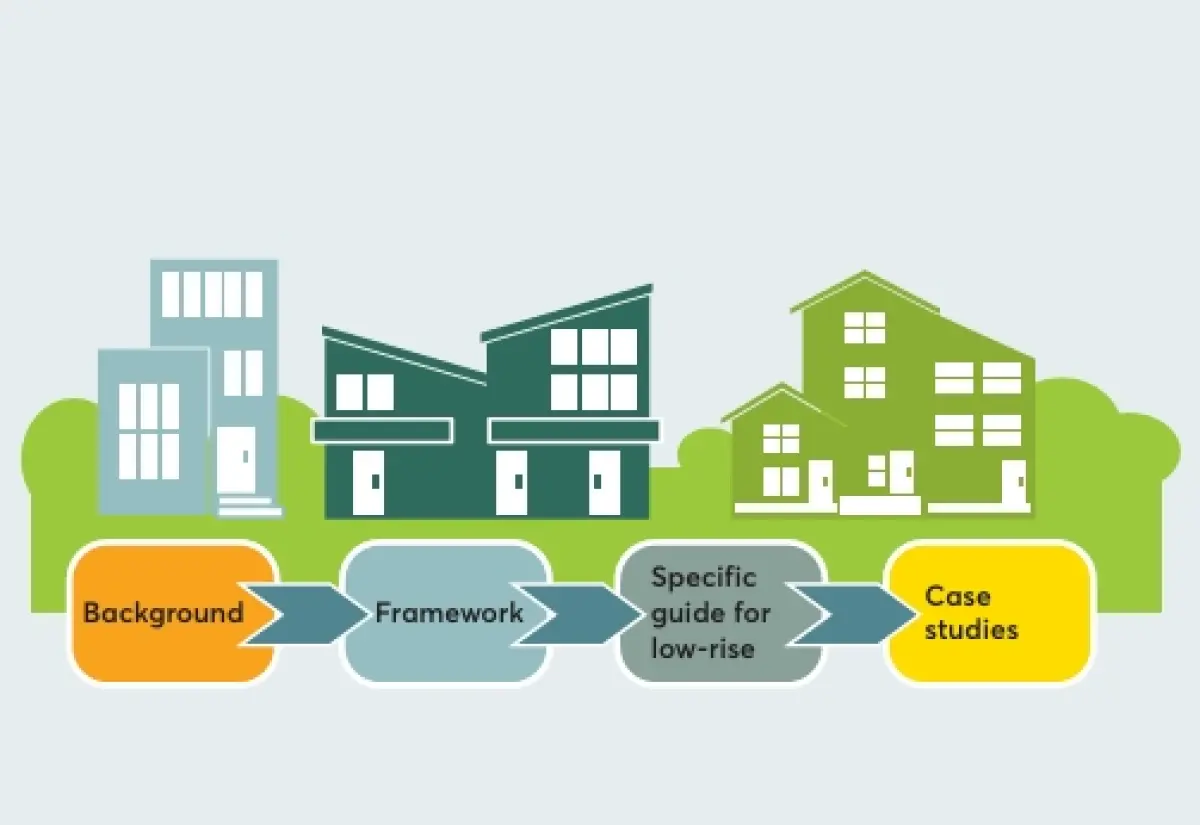
The project began with a review of existing low-carbon strategies and solutions to identify key strategies. The next step is developing a general design framework that can be used as a template for guidance specific to different materials, building typologies and structural systems and real-world case studies to demonstrate how the framework and guidelines work together (Figure 1).
The project team will pilot the application of the framework as a template for specific design guidance in a low-rise building project using steel and steel-hybrid systems, with learnings from the pilot helping to improve the framework.
The framework
The framework will highlight aspects of low-carbon building design with the greatest potential for reducing CO2 emissions while promoting circularity in the construction sector.
The framework will be based on a hierarchy of strategies from established international models and identify circular and low-carbon building design approaches with the most impact that should be considered early in the design process. Each strategy will be described using implementation steps to reach actionable solutions.
The framework will also identify the life cycle assessment (LCA) modules of each solution, enhancing understanding of LCA and emissions over time.
LCA
This research project adheres to ISO 14044 and EN 15978 guidelines for conducting carbon LCAs. ISO 14040 outlines four phases of an LCA study, while EN 15978 specifies the system boundary, functional unit and calculation rules.
The LCA evaluates the environmental impact of the building from cradle to cradle over 50 years, with the gross floor area as the functional unit. The life cycle inventory analysis phase compiles input/output data on the material composition of the building to determine the embodied carbon of each material. Only structural materials used in the superstructure and substructure are considered.
Specific guidance for implementation
The design guidelines, tailored to specific materials, typologies and structural systems and incorporating technical information and design steps, will support the successful implementation of low-carbon design solutions into buildings.
While the framework may be globally applicable, the guidelines must align with local design standards and building codes. The compliance of any design solution developed using the standards, building codes and regulatory framework of another country must be verified in Aotearoa New Zealand.
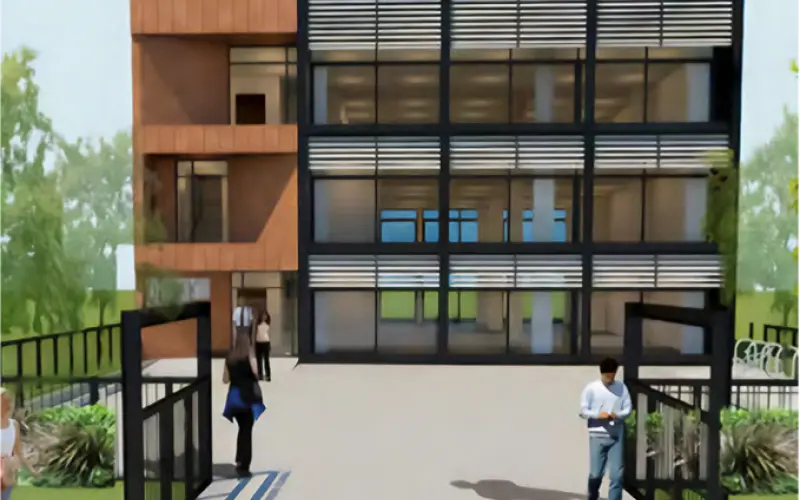
3-storey case study
To showcase the practical effectiveness of the framework and guidance, a real-world case study is being used (see Figure 2).
The 3-storey Christchurch office building’s lateral resistance systems incorporate reinforced concrete shear walls in one direction and moment-resisting steel frames in the perpendicular direction. Steel-concrete composite flooring systems are used throughout. The substructure of the building comprises a raft foundation.
Using the framework and specific design guides, several low-carbon strategies and solutions will be implemented in the building case study.
Preliminary results
Preliminary results indicate that available low-carbon design solutions for low-rise buildings in Aotearoa can help to significantly reduce carbon emissions – contributing to national emissions-reduction targets.