

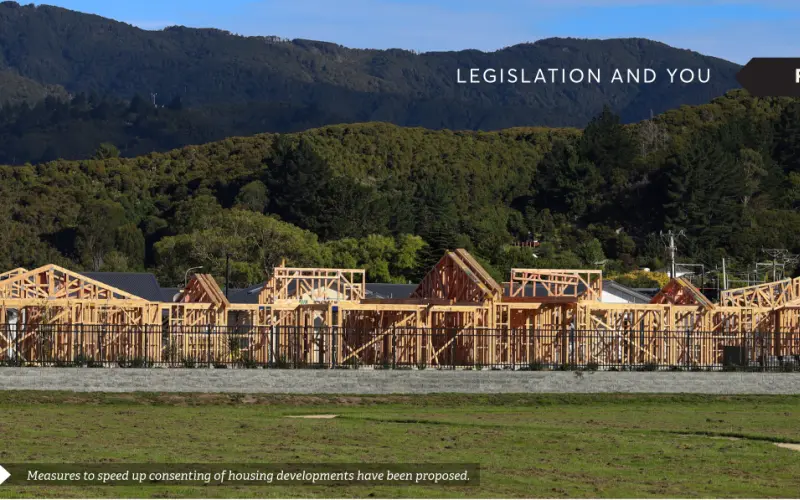


The legislation to replace the Resource Management Act (RMA) has been released, with the Natural and Built Environment (NBE) Bill and the Spatial Planning Bill introduced to Parliament recently. The Bills represent a step-change in environmental and resource management in Aotearoa New Zealand, with significant anticipated impacts on the building and construction industry.
The government says that the newly increased insulation requirements to comply with Building Code clause H1 Energy efficiency aim to reduce the energy needed to heat new homes by up to 40% compared with the previous requirements.
Balancing development with protecting the environment
The purpose of the reforms has always been how to solve the dichotomy between protecting the natural environment while enabling development of the built environment efficiently. In our view, this dichotomy remains troublesome despite the proposed legislation.
The two Bills were out for public consultation with submissions due on 30 January 2023. The Select Committee’s ability to refine the Bills will be essential to their workability and how they will shape the country’s future.
Architecture of the new legislation
The NBE Bill seeks to provide an integrated framework for regulating both environmental management and land-use planning. The core functions of the RMA will be replaced by the NBE Bill, which will set out rules relating to consenting, notification, plan making, responding to natural hazards, compliance and enforcement, and a range of other measures.
The NBE Bill also sets up the National Planning Framework (NPF), which will consolidate and replace existing national direction – national policy statements and national environmental standards. Regional combined plans will sit beneath the NPF and combine existing district and regional plans.
The direction of the NBE Bill is set in its outcomes, limits and targets. They establish clear expectations on development and environmental performance. The outcomes, limits and targets reinforce environmental protection – development of urban areas and infrastructure must still meet the clear environmental bottom lines.
The Spatial Planning Bill sets a new approach for the development and implementation of long-term, strategic spatial planning across New Zealand. Spatial strategies will apply for each region, and regional combined plans must be consistent with regional spatial strategies.
The key elements of the proposed legislation expected to affect the construction industry are discussed below.
Consenting and notification
The NBE Bill proposes to streamline the resource consenting process. This will be welcome news to the construction and development sector. Te Waihanga has recently reported on the cost of consenting infrastructure projects, observing that, between 2014/15 and 2018/19, council consenting fees increased by 66% for non-notified projects and 124% for notified consents.
Consenting is also taking longer with median decision-making timeframes increasing by 50% between the same years. Measures to speed up consenting will be welcomed by the development sector.
For standard-track consenting, the proposed streamlining measures include:
- alternative dispute resolution to resolve consenting disputes
- the ability to request a technical review of draft conditions of consent when a consent application is being processed
The fast-track consenting process will continue to be available for significant infrastructure and housing developments.
One way the new system intends to streamline the consenting process is by largely removing the notification decision-making stage. Notification status will be set with activity status through the plan-making process.
Unless a plan provides otherwise, discretionary activities will automatically be publicly notified, and controlled activities will be processed without notification. This has the potential to significantly improve certainty in the consenting process. However, it relies on councils being willing to draft their plans accordingly, otherwise there will be a risk of even more publicly notified discretionary activities resulting.
In an attempt to thwart NIMBYism, ‘the maintenance and enhancement of amenity values’ is no longer a matter of national importance for decision-makers, and consent authorities will be required to disregard effects on scenic views from private properties and effects of social housing.
The new role of spatial planning
The Spatial Planning Bill contains a new framework for long-term strategic spatial planning. Spatial plans will include areas appropriate for urban development, rural use, resource extraction, and environmental protection as well as both site-based and network infrastructure.
Regional spatial strategies will have 30-year horizons. We expect this will offer investor certainty through a degree of continuity in the planning regimes around Aotearoa.
Regional planning committees will be assisted in taking forward regional spatial plans by forming implementation agreements with third parties. This is a step forward in terms of providing opportunities for kick-starting new brownfields and greenfields development at scale.
Urban development and design
There is a stronger emphasis on resilient development – in particular, avoiding natural hazards. Responding to climate change threats plays an important role in the proposed legislation, and we expect this to flow through into planning controls. There are also new powers to review and cancel consents where properties or developments are at risk of climate change effects.
No shortcuts!
The NBE Bill takes a hardline position on compliance and enforcement. There are a range of new compliance tools for councils, and the maximum fines have increased from $300,000 to $1 million for individuals and from $600,000 to $10 million for companies. Insurance against fines will be unlawful under the proposed changes.
Transition – the RMA’s extended twilight
The transition from the RMA to the new system is not going to happen immediately. To ensure a smooth transition, it is intended that most aspects of the new framework will not apply until a region has completed its new combined plan. This means that, for some regions, consenting will continue under the RMA for the better part of the next decade.