At a glance
- NZS 3604:2011 does not directly cover connecting two beams to one post, but its details can be adapted for this situation.
- Calculate the roof area supported by the post to determine the required fixing strength for each beam.
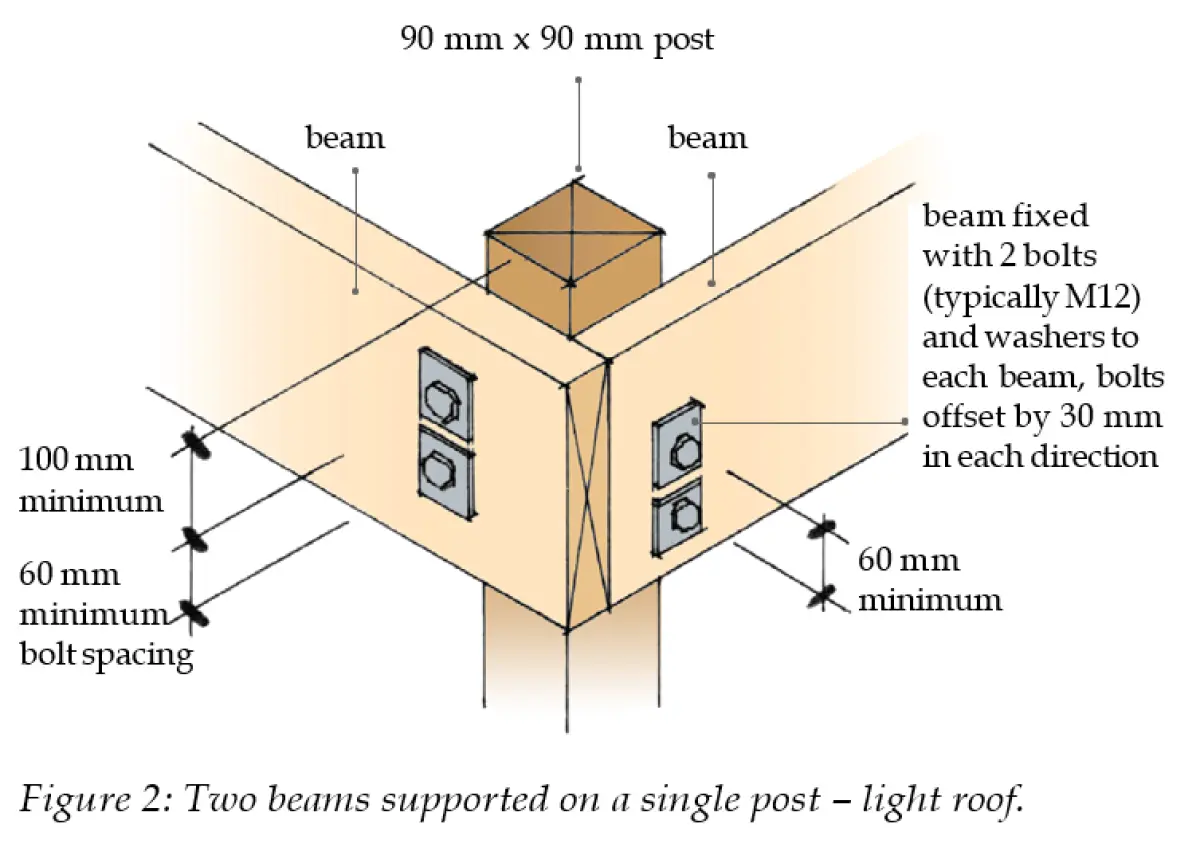
- For light roofs, two beams can be bolted to a corner post, ensuring proper bolt spacing and post extension above the top bolt.
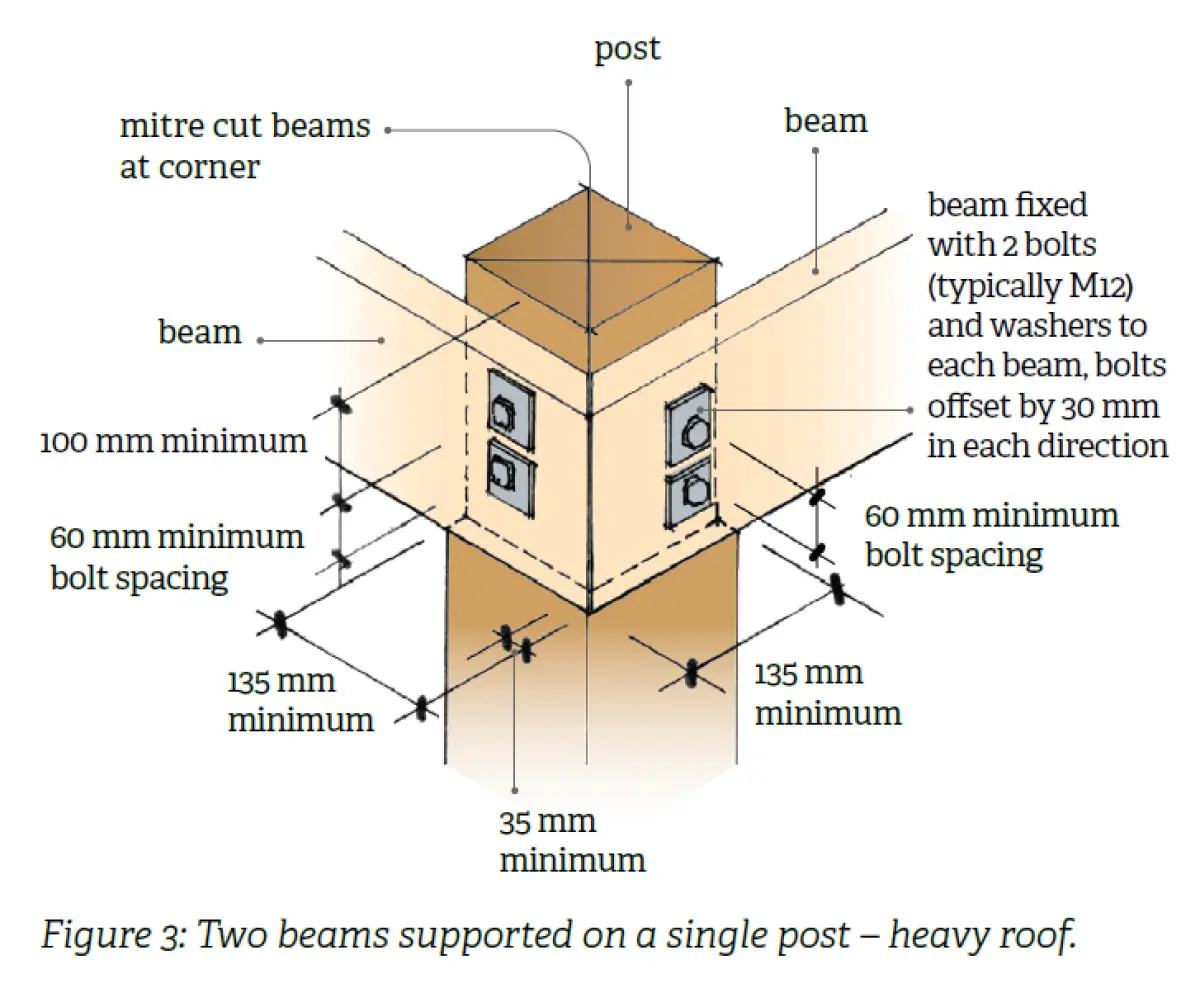
- For heavy roofs, use rebates cut into a larger post to support the beams, with similar bolt and post requirements.
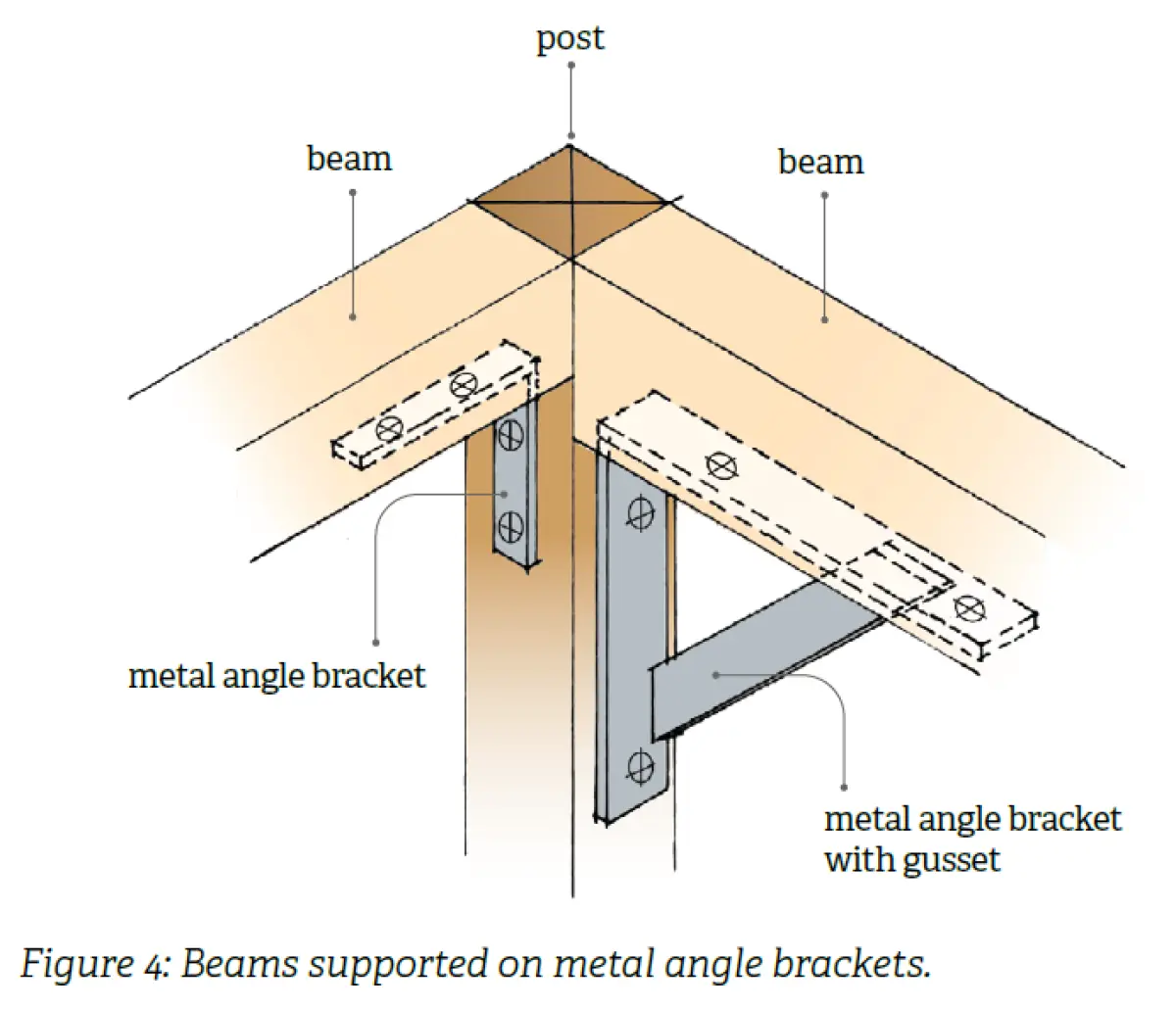
- Metal angle brackets (with or without gussets) are also suitable, provided manufacturer recommendations for strength are followed.
NZS 3604:2011 Timber-framed buildings section 9 deals with post and beam connections but only provides details for connections in situations where one beam is supported by a post. A question BRANZ frequently receives is how beam to post connections should be made where two beams are supported on one post. Note all aspects of post and beam designs must accord with NZS3604.
Connections to resist uplift
Section 9.2.1 requires that posts must be secured at each end against uplift. The required fixing capacity of the connections is based on the:
- area of the roof being supported by the post (referred to as the loaded dimension)
- type of roof – whether light or heavy
- wind zone.
The capacity of the beam to post connections based on the area of the roof supported is given in Table 9.2 and details of connection options are shown in Figure 9.3(A) – (D). Alternative proprietary connections of equal or greater capacity are also permitted.
Figure 9.3(A), (B) and (D) show beam to post connection details with a single beam supported on top of the post and bolt-fixed with either straight, T or L-shaped steel straps. Figure 9.3(C) shows an alternative detail with the beam seated on a rebate cut into the post with bolted connections through both post and beam. Bolts must be spaced 60 mm apart and the post must extend a minimum of 100 mm above the top bolt. This detail states that a rebate is not required for light roofs.
None of the details in NZS 3604 provide solutions to connecting two beams supported on one post – a situation typically occurring at corner posts.
However, the details in NZS 3604 can be used as the basis for connections.
Calculating the loaded dimension for two beams on one post
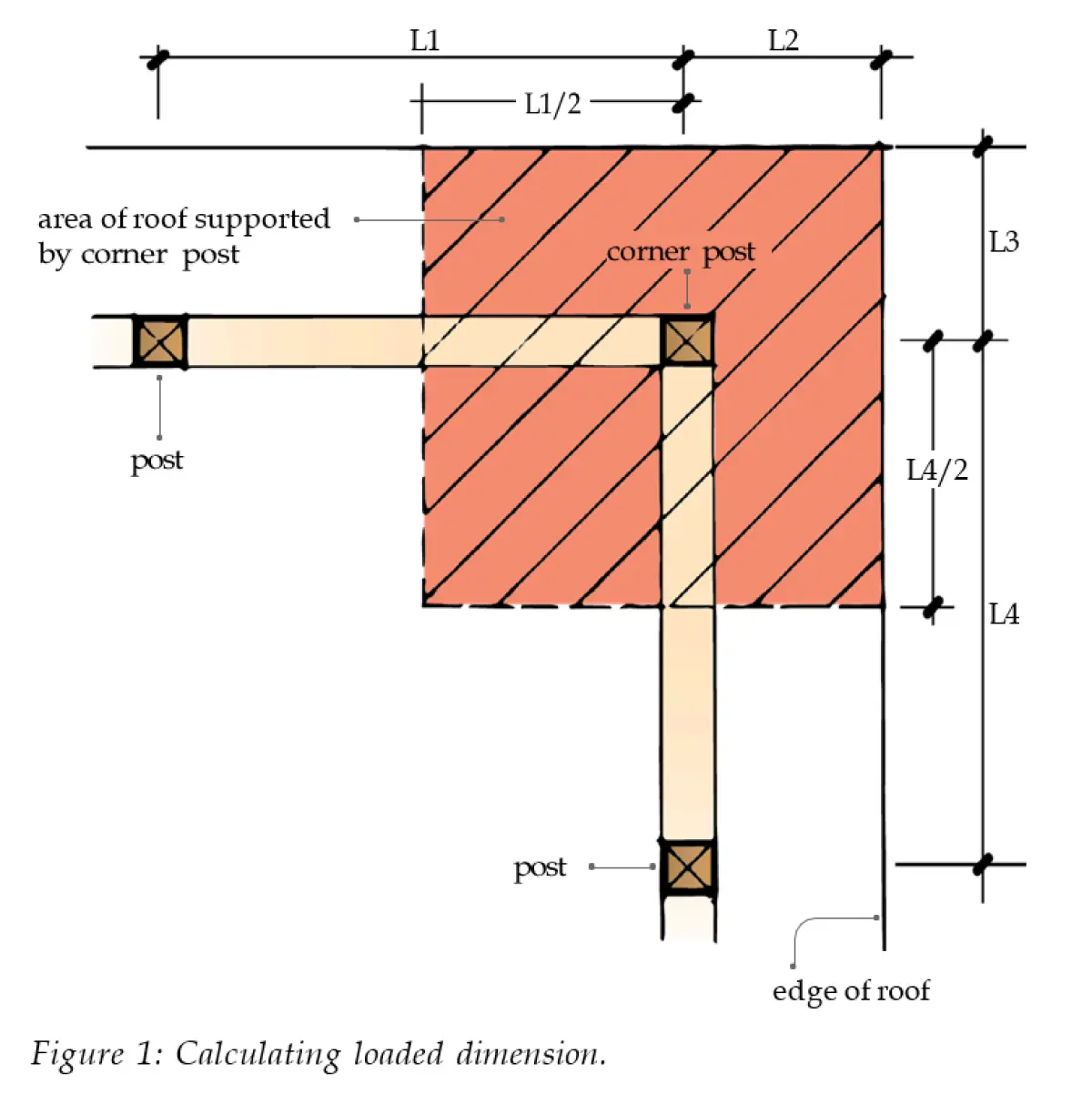
First, the required capacity of the connections to resist uplift must be determined by calculating the area or loaded dimension of roof being supported by the post. This is described in section 1.3 Figure 1.3(A)–(N).
The loaded dimension of a corner post may be calculated by the formula:
supported area = (L1/2 + L2) x (L3 + L4/2)
Refer to Figure 1. When there are two beams supported on a corner post, each beam must have the required fixing capacity to resist uplift as given in Table 9.2.
Solutions for supporting two beams
With the required fixing capacity determined, one solution for supporting two beams on a single post could be based on Figure 9.3(C) where the beam is seated on a rebate cut into the side of a 90 x 90 mm post.
As a rebate is not required for light roofs, Figure 2 shows an option where two beams may be bolted to a corner post. The beams must have sufficient depth to allow two bolts fixed in each direction with 30 mm minimum between the bolts at right angles to one another. The post should extend at least 100 mm above the top bolt.
Another solution is to support two beams on 35 mm rebates cut into the corner post as shown in Figure 3. In this situation, the post should be at least 135 x 135 mm and should also have 100 mm of post extending above the top bolt. The capacity of the bolt fixings is as per Table 9.2.
Other possible solutions using a variety of metal angle brackets, either with or without a gusset, are shown in Figure 4. As proprietary fittings, selection of fixing capacities should be in accordance with manufacturers’ recommendations.