



What E2/AS1 says
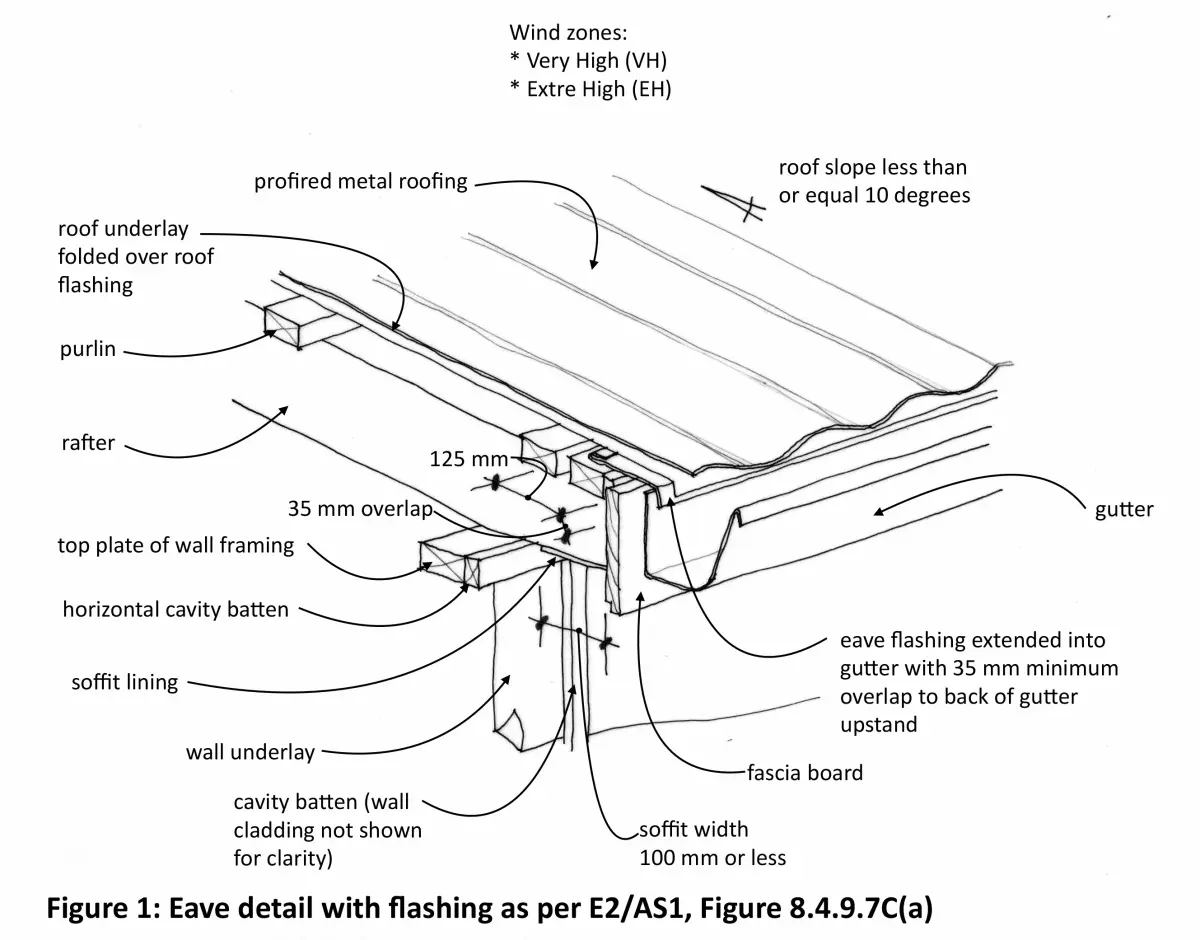
The ambiguity is between paragraph 8.4.9.7(c) and Figure 8.4.9.7C(a) in Acceptable Solution E2/AS1 (Figure 1).
E2/AS1 paragraph 8.4.9.7(c) states eaves flashing as in Figure 8.4.9.7C(a) required for all roofs under 10° pitch and soffit widths less than 100 mm. However, Figure 8.4.9.7C(a) comments:
Eave flashing required where all of the following conditions are met:
- roof slope less than or equal to 10°, and
- soffit width less than or equal to 100 mm, and
- wind zones are Very High or Extra High.
The enquiries made to the BRANZ Helpline were for clarification regarding, for example, is an eave flashing required where a soffit is wider than 100 mm, even if the wind zone is Very High or Extra High and the roof pitch is less than 10°?
As paragraph 8.4.9.7(c) does not refer to wind zones and Figure 8.4.9.7C(a) emphatically states where all of the following conditions are met, it can be interpreted that an eave flashing is not required.
What BRANZ recommends
However, as a first point, BRANZ always recommends use of best practice construction methods. This means not going for the easiest – or perhaps cheapest – construction method because the Building Code allows it, but to build beyond the minimum Building Code requirements, especially when it seems prudent to do so.
In the scenario described above, and in every situation where any one of the three conditions described in Figure 8.4.9.7C(a) is true, BRANZ’s recommendation is to include an eaves flashing even though it is not an actual requirement under the Code. For the relatively small cost and effort to include an eaves flashing during initial construction, the potentially destructive consequences of water ingress under the eave can be avoided.
What the MBIE Building Performance team says
In order to get clarification on the wording between E2/AS1 para. 8.4.9.7(c) and Figure 8.4.9.7C(a), I contacted the MBIE Building Performance Team, the government department responsible for building compliance documents. The response I received was as follows:
We acknowledge the discrepancy between paragraph 8.4.9.7(c) (“less than 100 mm”) and Figure 8.4.9.7C(a) (“100 mm or less”) in E2/AS1. This is a minor editorial inconsistency in how the soffit width threshold is expressed.
The Acceptable Solution should be read as a whole, and the figure provides the clearer indication of the intended threshold. For compliance, this requirement should be interpreted as requiring eaves flashing wherever the soffit width is 100 mm or less, subject to the other stated requirements.
So according to the Building Performance Team, an eave flashing is only required when all three conditions are met.
Although the response only referred to the soffit depth issue, the other conditions of roof pitch and wind zone, should be treated in the same way. That is, if the roof slope is less than or equal to 10°, and the eave width is less than or equal to 100 mm, and the wind zone is Very High or Extra High, an eave flashing must be installed.
The Building Performance Team response went on to say that the wording inconsistency in Acceptable Solution E2/AS1 will be addressed in a future amendment to align the paragraph text with the text in the Figure 8.4.9.7C(a).
What the NZ Metal Roofing Manufactures Code of Practice says
NZ Metal Roofing Manufacturers (NZMRM) Code of Practice provides additional information regarding eave details. The Code of Practice v.26.03 (effective from 1 March 2026). Section 8.5.4.4 Eaves Flashing states that:
Gutter eaves flashings are not required for weatherproofing unless the building is in a very exposed location and the eaves are not protected by spouting. They can, however, serve a purpose in many applications of improving the durability of roofing at the eaves.
The flashing should extend into the gutter, and the underlay finishes on the down-slope of the flashing. If there is no over flashing to the gutter, the underlay should be extended into the gutter by a maximum of 20 mm.
Unwashed flashings should be made of durable materials such as organic coated steel, aluminium, or PVC.
Eaves flashings as referred to in E2/AS1 are not required for weatherproofing unless the eaves are unprotected by spouting, but they can make a contribution to durability.
While the wording is different to that of E2/AS1, the intent is the same, that is, roof detailing should have durability as a primary aim. Furthermore, this principle should be applied in any aspect of ambiguity of the Building Code: aim for best practice not minimum requirements.