

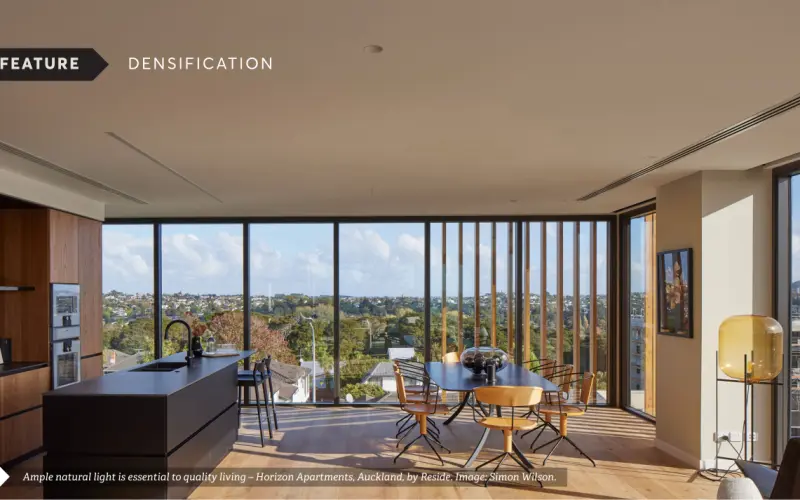


The densification of Auckland is well under way. According to Stats NZ, the Auckland region consented more townhouses, flats and units over the last 5 years than the rest of the country combined. Multi-unit consents numbered 16,228 in the year ending July 2022, up a massive 32% from the previous year.
But are we getting design quality that supports the health and wellbeing of our communities? And how should we move forward under increasing pressures, including extreme weather events?
Policies and standards
Policies that govern what gets consent have the most impact on the quality of our built environment. The Auckland Unitary Plan (AUP) is designed to shape the way Auckland grows. It became operative in 2016 and is intended to support quality residential development by setting out objectives at site, street, block, neighbourhood and city levels. It’s a framework for creating a liveable city while managing our resources and preserving our natural environment.
The AUP is being amended to accommodate two recent legislative reforms – the government’s National Policy Statement on Urban Development (NPS-UD) and amendments to the Resource Management Act. The latter includes the Medium Density Residential Standards (MDRS), which require high-growth councils across New Zealand to ease restrictions on what can be built without resource consent. The intent is to boost and diversify housing supply.
Under the amended AUP, more development will be enabled, particularly around town centres and public transport corridors. In most residential zones, up to three homes of up to 3 storeys will be allowable.
It remains to be seen what impact this will have on the city and on design outcomes. Auckland Council is currently working through its changes to the AUP, and until the document is finalised in 2024, most developments will still reference the existing AUP rather than taking advantage of the legislative reforms. This lack of certainty, coupled with rising interest rates, inflation, skyrocketing building costs and associated funding challenges, will stall the rate of development we’ve seen in recent years.
Assessing quality
Auckland Council has monitored the AUP’s impact on the quality of the built environment, and the results were published in a report in July 2022. The report sampled 130 residential developments of all sizes and typologies. Assessment criteria included access to outdoor spaces, sunlight, privacy and peace – four pillars of residential amenity that, as architects, we consider the baseline for well-designed dwellings.
The assessment concluded that the AUP has been effective in meeting growth objectives and has delivered good-quality street frontages for the most part. Less successful was achieving the desired character, with concerns about overall site amenity and functionality and the negative impact of new developments on the future development of adjacent sites.
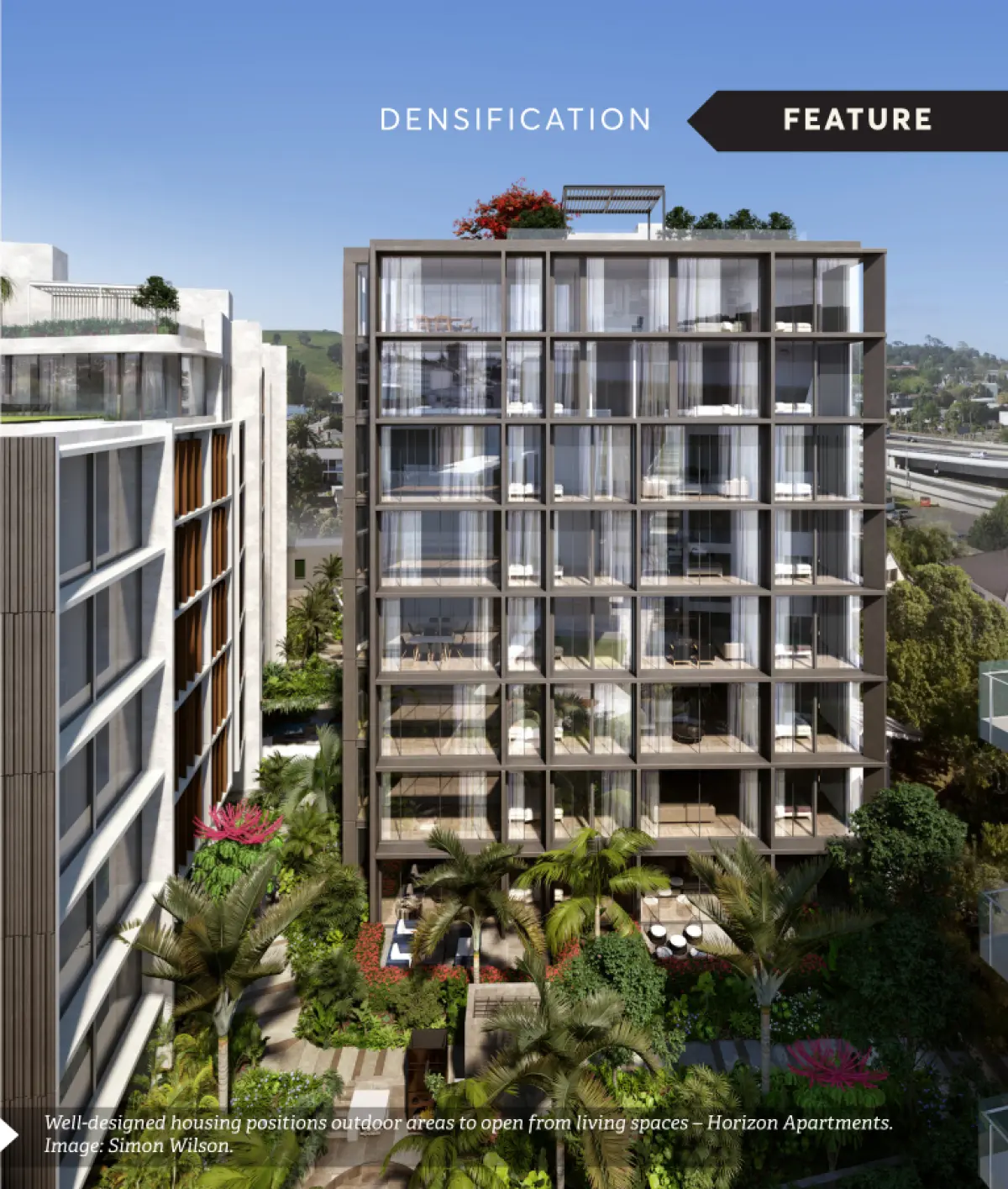
Some issues identified
Recurring issues with scale, orientation and bulk were identified, with associated overshadowing and compromises to privacy, natural light and outdoor amenity. These problems are often directly related to Auckland’s existing subdivision pattern of long, narrow sites, originally developed for stand-alone houses, not high-density housing.
Amenity was also diminished where excavation required high retaining walls, effectively putting dwellings below ground level. Approximately half of the developments had some or all their dwellings with primary living areas facing adjoining sites. There was also an increase in the number of outdoor living spaces being accessed from garages, bedrooms or laundries rather than the principal living area.
Council examines effectiveness
It is commendable that Auckland Council has undertaken a detailed analysis of the efficacy of its policy, and not all development falls short. Kāinga Ora, for example, is doing great work in establishing a range of terraces and apartment typologies throughout Auckland in the social housing sector. There are many architects delivering excellence in medium and high-density residential design. We know how to do it.
From the Auckland Council report, however, it’s clear that densification is not delivering the standard of design we need to provide quality housing for all and create the communities we want in the future. Most people appreciate that increased density is necessary to tackle the housing crisis and make the most efficient use of resources. Improving the quality of what gets built will lead to a more educated and sophisticated market and buyer – one that, in turn, will drive developers and architects to create a better product.
Design for disaster
Recent extreme weather events around the nation show the damage, disruption and high cost of natural disasters. It’s critical that we act now to make homes safer and insurance cheaper and enable communities to recover more quickly in the wake of floods, earthquakes and cyclones. This is not a problem that will go away, and we need to urgently tackle it.
Buchan New Zealand Regional Operations Leader and Christchurch Principal Raylene McEwan has spent over 20 years working on resilient design and warns against ignoring the past. ‘The landslides that occurred in the recent cyclones also occurred in the same place causing fatalities in 1965. The learnings have not carried through inter-generationally, and we are seeing the same thing with earthquakes.’
In Auckland, flooding has always been factored into planning, yet the most recent floods have recalibrated the 100-year event markers and moved the goalposts. We need to add safe and resilient to the criteria for well-designed housing.
This requires a shift in the way we design now and investment in researching and testing new materials and techniques.
Good urban design is key
Densification done well relies on more than quality housing design. It also relies on good planning and urban design. Providing schools, open space, retail and commercial and community facilities and public transport – all within walkable distance – supports efficient infrastructure and creates the high-level amenity that is the foundation of good communities. The more integrated, the better.
Planning experts are crucial to this integration. Working alongside planners, we can positively influence the quality of our housing design and our communities.
Auckland-based planner Michael Campbell suggests that aggregating our long, narrow sites, for example, is a way to make more efficient use of land and create better urban form outcomes. In his view, the recent floods are a reminder that densification requires a holistic approach that uses resources efficiently, recognising that a lack of infrastructure is one of Auckland’s biggest challenges.
‘It’s about prioritising spending and using development as a positive to fund growth to upgrade infrastructure,’ says Michael. ‘There are opportunities to do a catchment-wide analysis of urban areas and make efficient use of land. Where relevant, you dial back development and create recreation space and flood storage capacity.’ He cites Waitākere’s Twin Streams project as an exemplar.
He also cites Hobsonville Point as an example of good integrated urban design offering a range of density and housing styles set within a network of parks, schools and commercial development.
As Auckland’s densification continues, we need to be vigilant and continue to assess what is working and what isn’t, with a clear vision of how we want our city to evolve. It is the responsibility of all – policy makers, urban planners, developers, architects, builders and the community – to champion good design and ensure that well-designed housing is accessible to all, not just the few. Let’s aim high – I’m optimistic that we care enough about our city and its people to work through the challenges and set the bar for good design where it should be.