

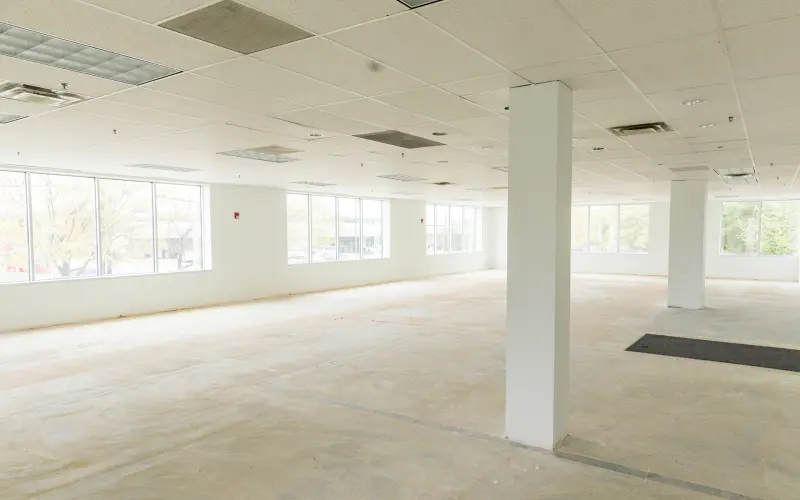


For the past 12 years, BRANZ has been developing resources to help industry assess the carbon footprint of office buildings. Until now, these resources have not accounted for the embodied carbon of interior fit-out elements such as partition walls, ceilings and carpet.
However, overseas evidence suggests that office fit-outs can be very carbon intensive. BRANZ has researched the carbon footprint of a fit-out and compared it to the carbon footprint of the office building as a whole.
What is a fit-out?
A fit-out refers to the process of installing elements within an office space to make it suitable for the occupant or a particular kind of business.
A fit-out is distinct from the base building, which usually refers to a building’s main structure and envelope.
A fit-out might involve installing partition walls to create individual rooms and offices, lining the floor with carpet, installing a ceiling or moving in furniture.
Fit-out projects can range in size from small sections of a single floor to an entire building. A single office space can also be fitted out multiple times throughout its existence as the occupants’ needs or the occupants themselves change.
Global research into fit-out and carbon
So how does fitting out an office contribute to carbon emissions? How do those emissions compare to the rest of the building?
Research in the US and Australia suggests that fitting out an office could contribute significantly to a building’s carbon emissions. The research identified three contributing factors:
- High-carbon materials: The Carbon Leadership Forum in the US found that fit-outs typically use materials with high embodied carbon such as aluminium for partitions, carpet, plasterboard and furniture.
- Frequent refurbishment: Research in Australia found that office spaces are refurbished on average every 8.2 years to meet the changing needs of occupants or when tenancies change. This results in a lot of additional material – and thus carbon emissions – given a building is expected to last at least 50 years.
- Lots of waste: Research in Australia also found that removing existing fitout material such as during a refurbishment generates a large amount of waste that is usually sent to landfill.
These factors create a perfect storm for carbon emissions. High-carbon materials are installed and then removed and replaced frequently, and when they are removed, they are sent to landfill.
Towards Aotearoa data on fit-out
BRANZ sought to integrate this information into a study of carbon emissions that result from fitting out an office in Aotearoa New Zealand and assess how those emissions compare to the total emissions of the base building. Three case studies based on realworld fit-out projects were undertaken.
BRANZ used the case studies to estimate average carbon rates to fit out 1 m² of office space, calculating the carbon emissions to fit out reference office buildings that BRANZ has already carbon footprinted. Results
We calculated that fitting out an office building can release an additional 480 kgCO₂e per m² (net lettable area) into the atmosphere over a building’s 50-year service life.
Figure 1 shows how this translates to whole buildings in the carbon footprint of 10 of BRANZ’s reference office buildings. The red sections illustrate the carbon footprint of the fit-out, and the red figures show the percentage contribution of the fit-out to the whole building’s carbon footprint.
When compared to the emissions of the base office buildings, the fit-out contributes approximately 25% of a whole building’s gross carbon emissions on average.
For context, this is a similar percentage to the base building’s upfront emissions, which are often the main focus of decarbonisation strategies. Only operational energy use contributes more significantly to a building’s carbon emissions.
Decarbonisation strategies
Clearly, fit-out needs more consideration when low-carbon design decisions are made for our office buildings.
The research identified several particularly effective strategies for reducing the carbon footprint of a fit-out:
- Extending service life: The short service life of fit-outs and therefore frequent refurbishments are a key contributor to high emissions over the lifetime of a building. Extending the service life of fit-outs will lower emissions.
- Reusing furniture: Among all materials and products used in a fit-out, furniture contributes most to the carbon footprint. Reusing furniture (reducing the need for the manufacture of new furniture) lowers this impact.
- Diverting furniture from landfill: If furniture can’t be reused, diverting it from landfill is the next best thing. Options include selling it to employees or donating it to a reuse/recycling organisation such as All Heart NZ.
- Retaining materials between refurbishments: Many materials are still fit for purpose when they are removed during a refurbishment. Retaining these materials can help to reduce the carbon footprint of the fit-out.