


NZS 3604:2011 Timber-framed buildings provides for cantilevered joists to support balconies, decks and enclosed spaces. The requirements for joists in these three situations differ, so each has been described below.
Balcony
Balconies are defined in NZS 3604:2011 as open floors projecting from the external structure and supported on cantilevered joists.
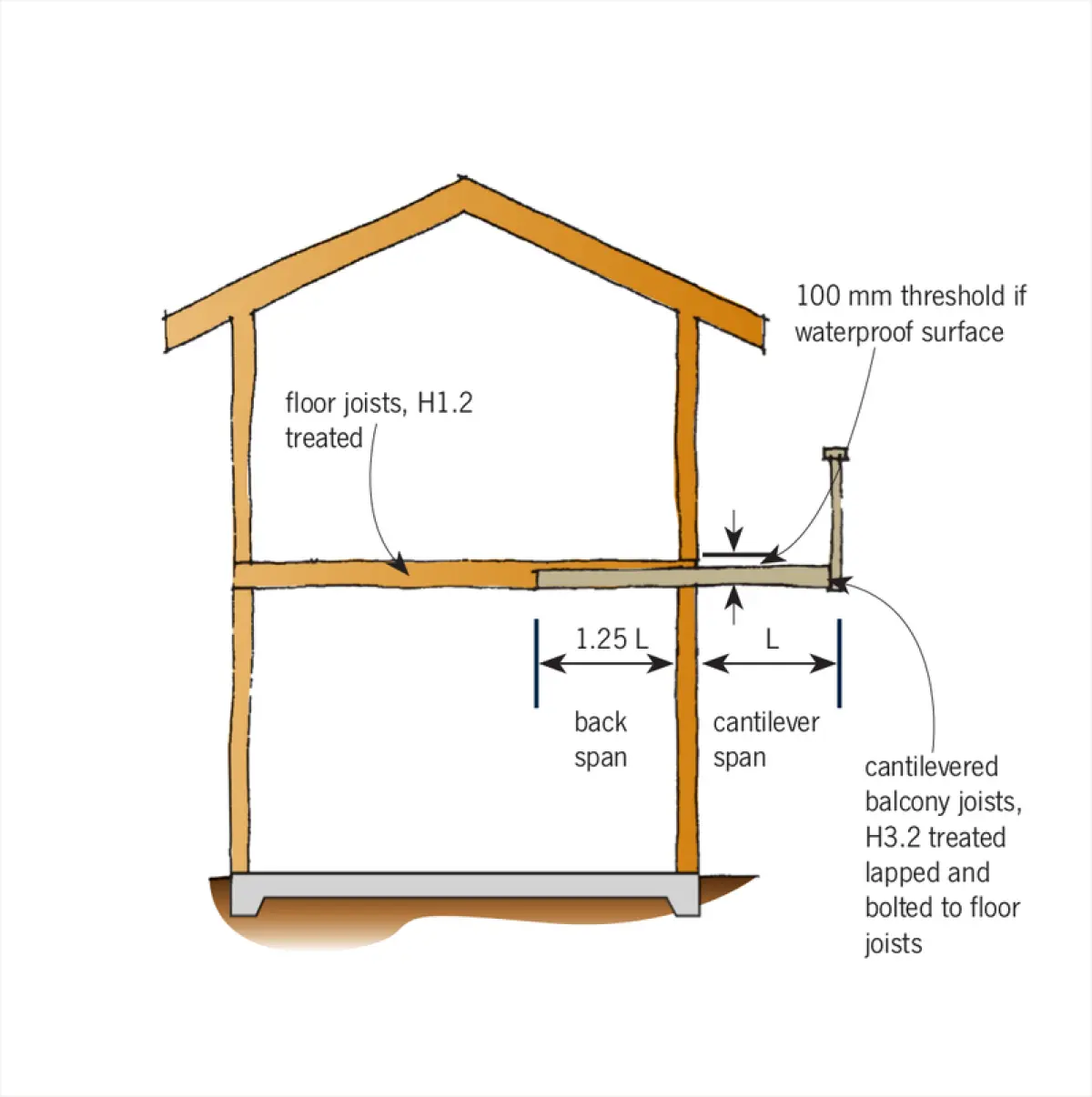
A balcony situation with a waterproof deck surface (see Figure 1) requires a level difference (or threshold) between inside and outside to prevent rainwater entering the building. The vertical separation of 100 mm from threshold top to waterproof surface is required in E2/AS1. If the balcony has a slatted deck that allows drainage, a 50 mm set down is required and the joists must be saddle flashed (see E2/AS1 Figure 16 and NZS 3604:2011 Figure 7.6).
If a raised threshold detail is not used, the top surfaces of the internal and cantilever joists need to be at different levels. This requires separate members, as shown in Figure 7.6 of NZS 3604. (Note that the word ‘notched’ in the figure title is an error and should be deleted).
Separate members are used for two reasons:
- Cantilever joists will need treatment to at least H3.2. If 50–100 mm is ripped off the top surface of the timber after treatment to create a set-down, the timber treatment may be compromised.
- Timber is graded in its original sawn sizes. The critical determinant of its strength is the size of the defects (for example, knots) in relation to the size of the section. Reducing section size by ripping invalidates this process.
For selection of cantilever joists in balcony situations, use Table 7.2 of NZS 3604:2011 (right-hand column) and follow the back span details of Figure 7.6.
If a cantilevered barrier (one that is only attached at its base) is required at the end of the joists, a minimum 190 mm deep joist size is needed to accommodate the fixing details of clause 7.4.1.3.
Slatted deck
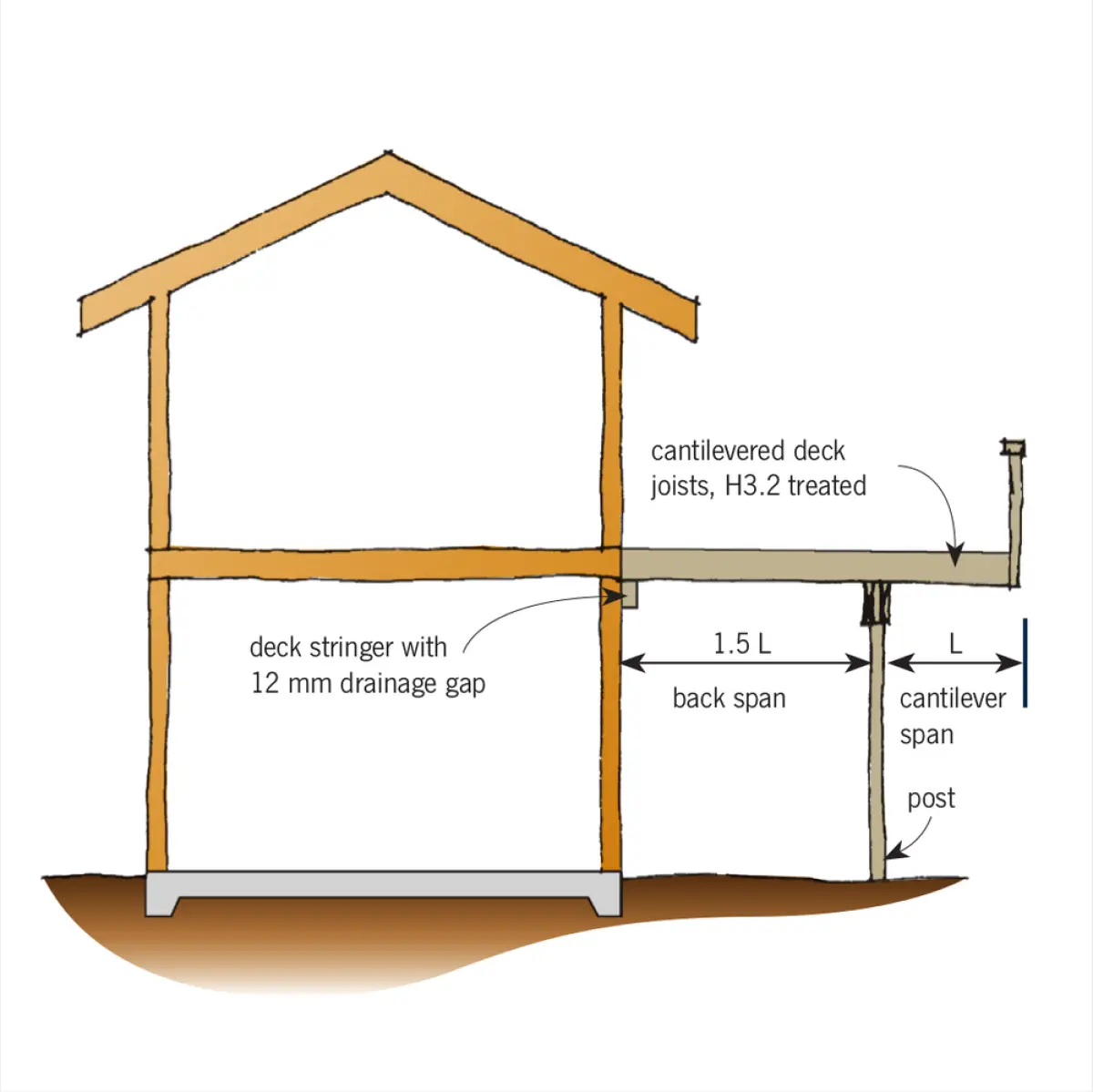
Decks are defined as open platforms supported on framing. The joists may be cantilevered beyond the outer row of supports. No difference in levels is required in decks, so cantilever spans will normally be continuous with the back spans (see Figure 2).
All joists are exposed to the weather so will need at least H3.2 treatment. Again, selection of cantilever joists may be made from Table 7.2 of NZS 3604:2011 (right-hand column).
Where the joists are continuous back to the next support (which will usually be the case for a deck), there is no restriction on back span in NZS 3604. Bearing in mind that joist fixings to their supports are likely to be only two skew nails into the bearer, a short back span length has the potential for the joist to overturn about its outer support when loaded. For this reason BRANZ recommends a minimum back span of 1.5 times the cantilever length for deck joists (see Figure 2).
The same restriction on joist size applies (minimum 190 mm deep) where cantilevered barriers are attached to the ends of deck joists.
Enclosed space
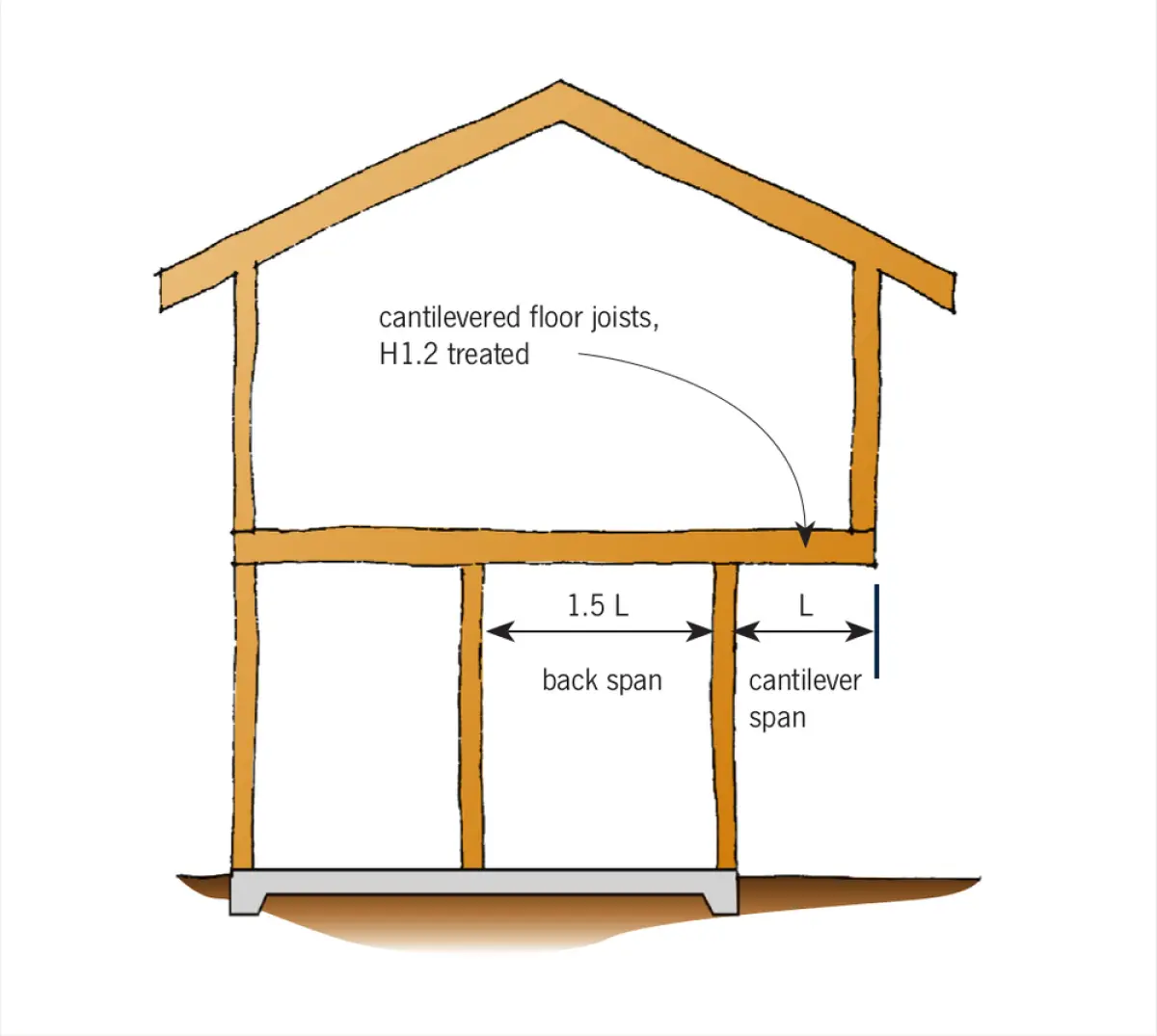
Enclosed spaces (see Figure 3) also do not require a floor level difference, and the timber treatment may be to H1.2 only.
Selection of these joists is again from Table 7.2 of NZS 3604:2011, but using one of the first six columns, depending on the roof weight and span.
In enclosed spaces, the inner ends of the joists may be adequately anchored down by an internal wall. However, if this is not the case, the recommended back span length of 1.5 times cantilever length should also apply, or an alternative fixing should be used.
If the wall at the end of the cantilever contains bracing elements, additional vertical loads will be imposed on the cantilever joists and the brace elements may not function correctly. In this situation, specific engineering design is required (possibly resulting in some joists being doubled up).
Lateral support needed
Cantilevered joists need lateral support by snugly fitted continuous blocking. Frequently, the wall from which they cantilever has a bracing element in the storey below, in which case, blocking is required by clause 7.1.2.1 of NZS 3604:2011 and Figure 7.2.
BRANZ recommends that all cantilevered joists have continuous blocking at the line of the cantilever support wall. This blocking will also support any flashing that may be required (see Figure 7.6 of NZS 3604:2011).