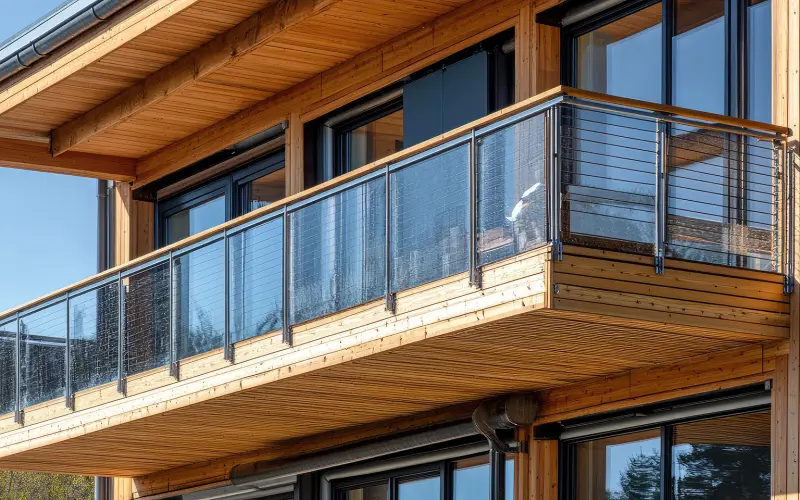


A deck or balcony cantilevered from a building presents structural and weathertightness issues not encountered with non-cantilevered decks (see Figure 1).
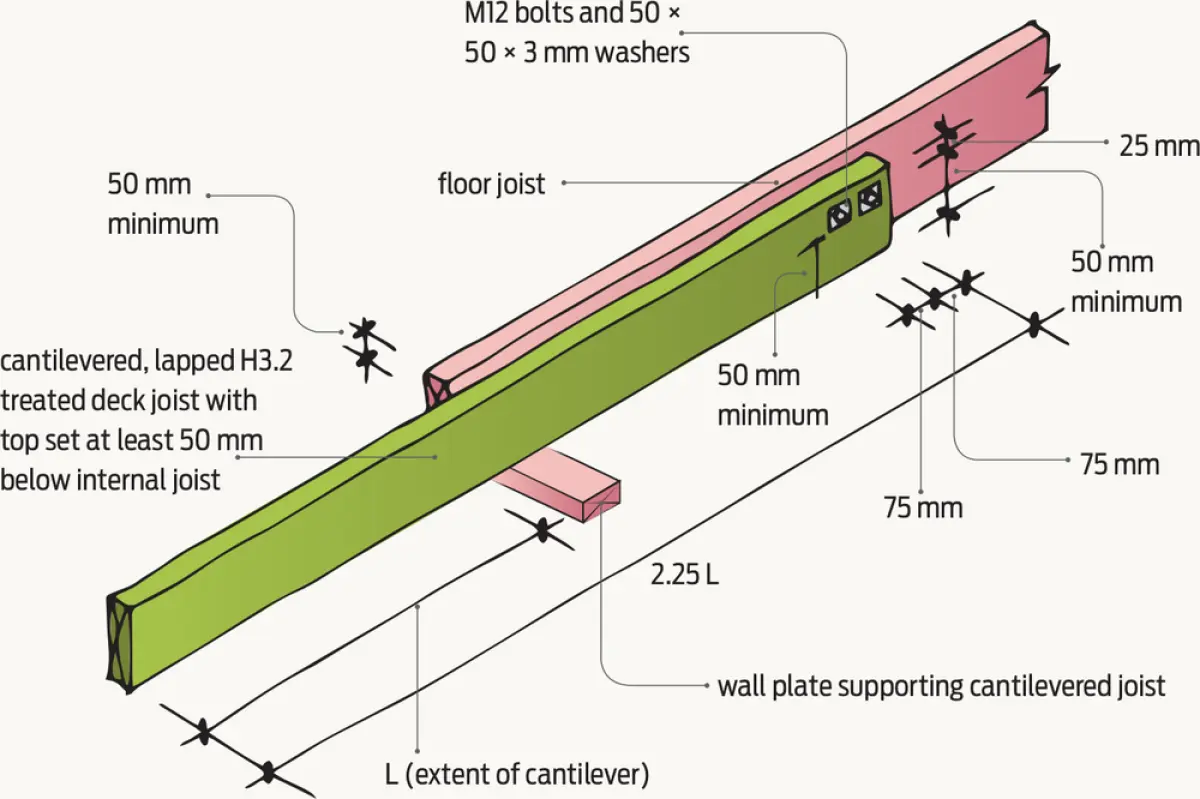
Construction consists of deck joists installed alongside and bolted to the floor joists extending over the external wall framing. The back extension alongside the floor joist must be at least 1.25 times longer than the length of the cantilever (see Figure 2).
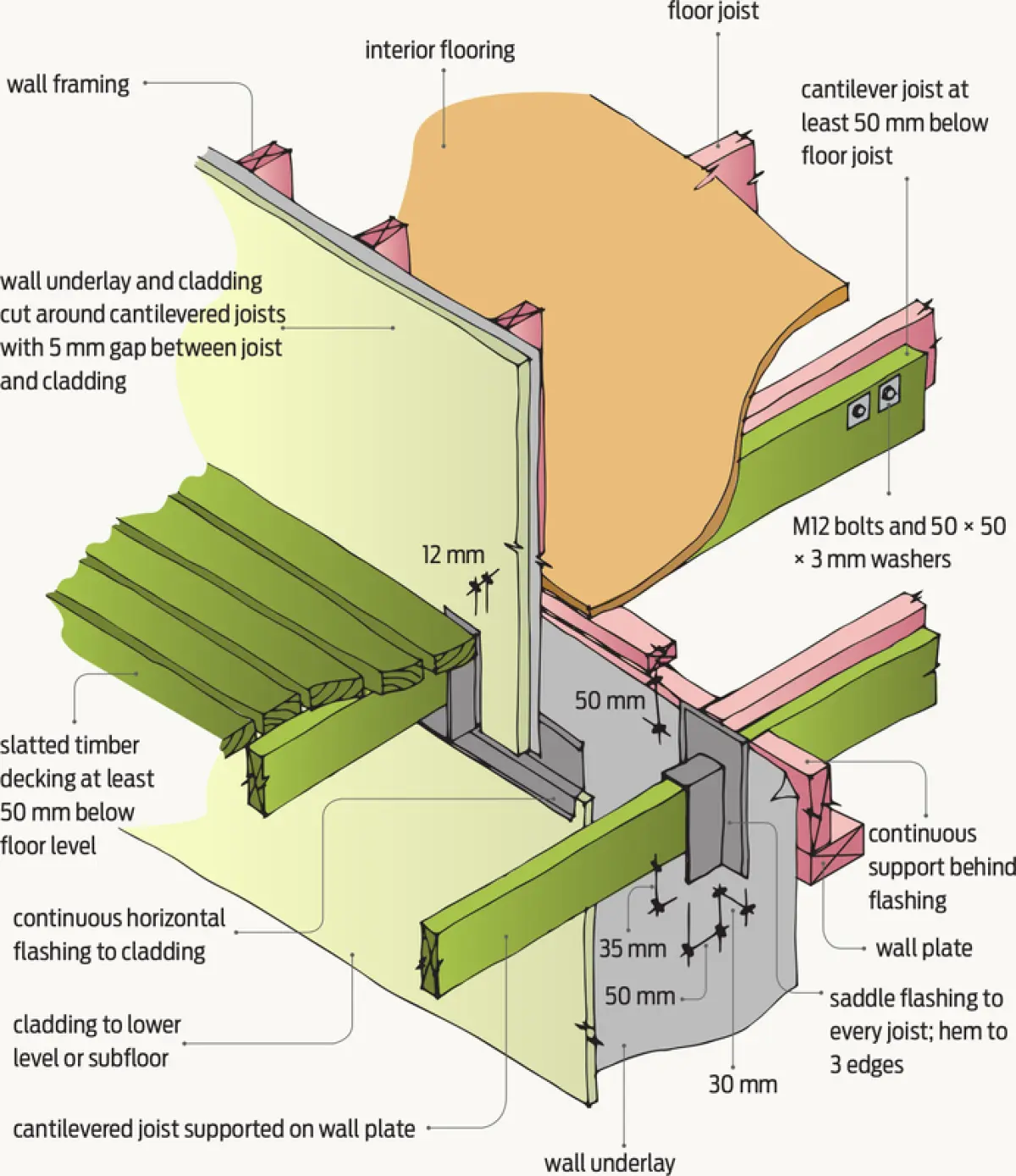
The finished level of a cantilevered deck with slatted timber decking must be at least 50 mm below the finished floor level or threshold of the building interior (from E2/AS1).
Joist treatment and fixing
Cantilevered deck joists must be treated to hazard class H3.2 and bolted to the floor joist with two M12 bolts and 50 × 50 × 3 mm washers at the innermost end of the cantilevered joist.
Projections and support
NZS 3604:2011 Timber-framed buildings Table 7.2 sets out cantilever projection distances for different sizes and spacings of joists where the floor load is 2 kPa and the timber is SG8 (structural grade) wet in service.
NZS 3604: 2011 paragraph 7.1.5.1 states that cantilevered joists may not support:
- a decking weight of more than 40 kg/m², or
- a balustrade weight of more than 26 kg/m².
In addition, a cantilevered deck must not support a roof or other structure.
Cantilevered balustrades
At its outer edges, a cantilevered deck must be able to resist the bending loads of a cantilevered balustrade and have sufficient depth for structural post fixing of the edge barrier.
NZS 3604: 2011 section 7.4 and ‘Adjustment to the deck details in NZS 3604’ in Codewords 54 published by MBIE in December 2012 describe requirements for boundary and edge joists including that they must be the same depth as the deck joists and be screwed, bolted or coach-screwed together.
Durability of fixings and fastenings
Metal fixings and fastenings must have the same durability as the timbers they are connecting. Generally, all fixings and fastenings should be a minimum type 304 stainless steel where exposed, although hot-dip galvanised steel nails and screws may be used in zones B and C with CCA-treated timber.
However, where ACQ and CuAz timber treatment is used, nails, screws, bolts and washers need to be grade 304 stainless steel. Stainless steel nails should be annular grooved to provide a similar withdrawal resistance to galvanised nails (see Tables 4.1 and 4.3 in NZS 3604:2011).