

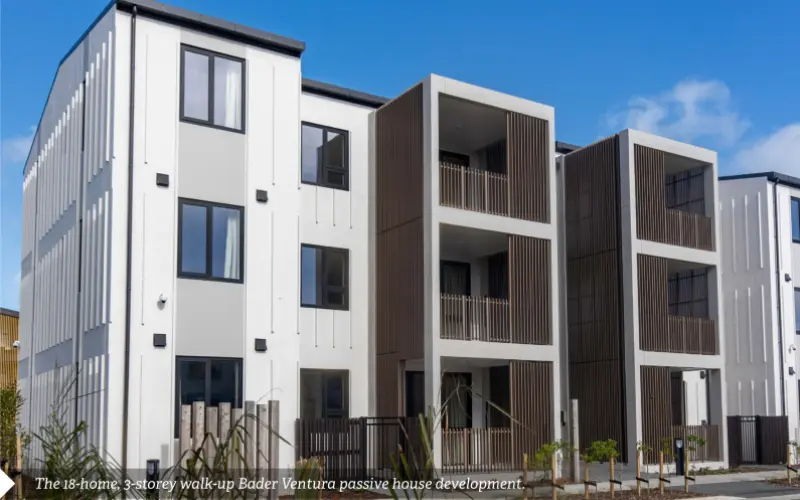


In June 2023, the completion of Bader Ventura marked a key milestone in the evolution of Aotearoa New Zealand’s public housing. More than just a housing project, this Māngere-based development reflects a commitment to innovation, to helping shift the dial on sustainable building practices and to environmental and customer wellbeing.
Testament to its impact, the Construction Sector Accord awarded Bader Ventura its Supreme Beacon Award – recognising the government’s efforts to lead the way in replicable, low-carbon construction that also benefits some of our country’s most vulnerable.
The public housing development is Australasia’s first to be funded by central government, is 8 Homestar version 4.1 rated and achieves MBIE’s Building for climate change programme’s proposed 2035 thermal demand performance cap by 2023 – 12 years ahead of expectation.
Surprisingly, the original concept for Bader Ventura didn’t include Passive House aspirations. In fact it came about during a conversation about windows.
From that simple conversation, a fire was lit within the entire project team, despite no one having prior Passive House experience and with no real roadmap to get there in an 18-home, 3-storey walk-up complex.
Innovative solutions
Throughout the two-year build, at every speed bump, the team’s guiding mantra was ‘Have we failed yet?’ – a constant reminder that innovation and progress always require pushing boundaries, taking calculated risks and thinking outside the box. At every challenge, we asked this question, adjusted our course and persevered.
Adopting the passive house standard
We knew that adopting the passive house standard meant meeting a high thermal performance target, which translated into several key build features:
- High airtightness, meaning the entire building envelope – roof, exterior walls, windows and floor – is well sealed so that there are almost no leakage paths, which typically feature along joins and service penetrations.
- Windows have high thermal resistance to heat flow (R-value of R0.61), equating to around 1.3 times better than a standard Auckland H1 5th edition house (R0.46).
- Considerably higher floor, wall and roof insulation, which is combined with smarter design and construction detailing to practically eliminate heat loss weak points – thermal bridges.
Environmental impact
Low-carbon concrete was used to help lower the environmental impact of the buildings. The combination of two cement replacement materials – Neocrete’s D5 Green and fly ash – in the precast sandwich panel cladding layer reduced the amount of cement required in the cladding layer by 24% and the embodied carbon impact by 18% compared to standard practice.
Beyond carbon benefits, using D5 Green also sped up the production of the precast sandwich panels due to its reduced curing time compared to typical lower-carbon concrete.
Ground conditions
Geotechnical site investigations found that ground conditions at Bader Ventura were less than ideal, with differential ground settlement, lateral ground movement and a high groundwater table.
To moderate these hazards, engineers Kirk Roberts considered that bottom-fed, displacement stone columns would be an effective solution. Non-vibration stone columns are an innovative technology developed in Aotearoa by McMillan Civil as part of the Canterbury earthquakes rebuild.
Stone columns were installed by drilling boreholes into the ground to a depth of around 6 metres and filling them with crushed stone. The columns were constructed in a grid pattern across the site in areas where the foundations sit. Not only did this stabilise the ground and improve loadbearing capacity, but it also sped up construction time and reduced disruption – important for the adjacent residential homes – due to the minimal noise, vibration and dust with this approach.
Customer-focused design
As Aotearoa’s largest landlord, we’re focused on improving the health and wellbeing of our customers, knowing they’re some of our country’s most vulnerable. As our highest-performing home designed to date, Bader Ventura shows us what’s possible in terms of healthy, energy-efficient and affordable public housing. Some of the key benefits for residents include:
- greater affordability in heating, cooling and ventilating their homes estimated at around $1 per day, with the average space heating energy use forecast to be less than 15 kWh/m²/year
- designed to deliver comfortable yearround temperatures targeting between 20–25°C
- fresh, filtered indoor air via the provision of the whole-house heat recovery ventilation system for year-round good-quality air
- benefits of Homestar such as water and energy efficiency, healthy indoor environment and being close to transport and amenities
- accessible friendly, with all six groundfloor units built to full universal design standard, which reflects our commitment to ensure more public housing meets the changing needs of New Zealanders so customers can live well and age in place.
Industry transformation
Under its Building Momentum Construction Plan, Kāinga Ora has committed to helping transform the sector, leading the way towards a low-carbon future and sharing our journey and lessons learned with the industry.
What better opportunity to achieve this than by improving and sharing our knowledge of building to passive house standard, particularly on a threelevel walk-up typology, which is fairly unknown in the Aotearoa context?
Already, Bader Ventura has given us a platform to engage with the wider industry, including an on-site deep-dive session into the design, specification and construction process as seen by our partners.
With the homes now occupied, our monitoring and evaluation phase has begun, with sensors capturing information on indoor temperature and humidity, air quality, electricity and water use.
Our aim is to understand and analyse customer health and wellbeing, resource use, build quality, developer experiences, lifetime costs, buildability and environmental impact. We’re also comparing these results to the neighbouring 6 Homestar version 4.1 development Bader McKenzie – together, this is a landmark research and innovation project.
This research will tell us whether our original performance thresholds and targets for Bader Ventura are achieved in practice and whether the piloted elements could become business as usual for Aotearoa through the MBIE Building for climate change programme.
Through Bader Ventura, we’re trialling ways to improve our build programme, support customer wellbeing and help the industry build its capacity to do things differently. Alongside our industry partners, we look forward to continuing to push the boundaries of what’s possible in public housing and to sharing our journey and insights along the way.
Bader Ventura has been a collaborative effort. Our project partners who were instrumental to the project’s success include Precision Construction, Peddlethorp, Kirk Roberts Consulting, Oculus, 2PiR and Sustainable Engineering. We would also like to acknowledge BRANZ scientists Steve McNeil and Andrew Pollard for their assistance in developing the monitoring research.