

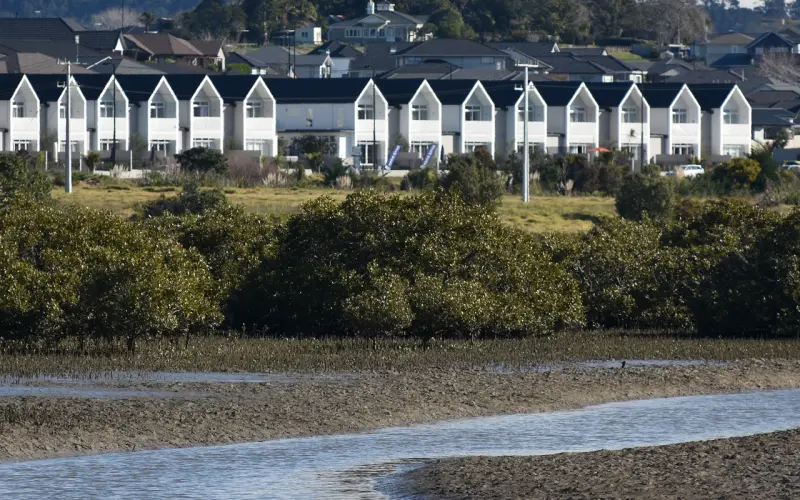


Climate change is altering how we think about housing in Aotearoa New Zealand. More frequent floods, storms and coastal hazards are exposing the limits of existing building practices. At the same time, hotter days and an increasing risk of droughts are testing how well homes perform in warmer, drier conditions.
A new report from the Ministry for the Environment and Stats NZ noted that around $180 billion worth of homes are located on flood-prone land, highlighting the scale of physical and economic exposure.
Most new houses continue to be built to the minimum standards of the New Zealand Building Code. A BRANZ report, Measuring our sustainability progress: New Zealand’s new detached residential housing stock found that, while homes consented in 2020 complied with the Building Code, few went beyond it. Developers and designers generally met the minimum requirements but did not take up available guidance or tools that could improve long-term adaptability or durability.
Meeting the minimum
The Building Code provides the baseline for safety, health and durability. It ensures houses are structurally sound and fit for occupation, but it does not necessarily make them resilient to future conditions, especially when the conditions and risks associated with climate change are evolving and causing uncertainty.
BRANZ’s research found that most new homes are designed for current household needs and present-day climatic conditions rather than for future risks. The study identified limited use of voluntary sustainability tools and concluded that incremental improvements and information-based initiatives have not significantly changed building practice.
The findings suggest there may be scope for clearer guidance through policy, regulation or market mechanisms to encourage more resilient housing.
Assessing adaptability and durability costs and benefits
NZIER has recently embarked on new research, funded by the Building Research Levy, to assess the benefits and costs of building homes that are more adaptable and more durable compared with a standard Code-compliant dwelling.
It’s looking into how easily a home can be adapted as needs, technologies or environmental conditions change and how well a home maintains its performance and condition over time with normal use and maintenance.
Adaptable homes are designed with flexibility in layout, materials and services. They can better accommodate changes such as ageing in place, multi-generational living or new energy and water technologies.
Durable homes are built to last longer and to perform well under a broader range of climate conditions, including more intense rainfall, warmer temperatures, heatwaves and prolonged dry periods that can affect water supply, soil stability and material performance.
Life cycle performance standards will be developed for adaptable and durable homes, drawing on both New Zealand and international evidence. A cost-benefit analysis will compare their long-term performance against a typical Building Code reference home.
The research will reveal:
- the additional upfront costs of design, materials and construction
- the potential long-term benefits from lower repair and maintenance costs
- broader social and environmental effects such as reduced waste, lower emissions and improved community resilience
The goal is to understand how these factors interact under evolving climate risks and whether higher-performing homes deliver value over their lifespan.
The role of economics
Building more resilient housing involves trade-offs between cost, performance and risk. Economics provides a structured way to weigh those trade-offs and to guide where investment will deliver the greatest overall benefit.
Cost-benefit analysis allows different building options to be compared on a consistent basis. It can quantify outcomes that are often difficult to express such as avoided damage, longer building life or reduced expo-sure to heat and extreme weather.
Policy makers, councils, developers and designers will be able to understand when higher standards make economic sense and what forms of support or regulation may be appropriate.
In a resource-constrained environment, economic analysis will identify where resilience provides measurable value.
Building confidence through evidence
The construction sector continues to adapt to changing expectations around performance, cost and regulation. Evidence-based research can help the industry and policy makers focus effort where it adds the most value.
The NZIER research aims to provide that evidence. If the analysis demonstrates that adaptable or durable housing delivers good long-term value, the findings could help encourage voluntary uptake, guide investment incentives or inform potential future updates to the Building Code.
Reliable evidence builds confidence across the system – confidence among builders and developers that higher standards are achievable and confidence among policy makers and homeowners that resilience investments are worthwhile.
A collective economic task
Climate change creates new and uneven risks for housing. Some of these risks fall directly on homeowners, while others are shared across insurers, local councils and the public sector through infrastructure and emergency response costs. This mix of private and public exposure means that resilience in housing is not just a technical issue but an economic coordination problem.
Well-designed policy and regulation can help align private investment decisions with wider social benefits. If homeowners, developers and builders face clear and consistent price signals about climate risk, they can make more efficient choices about where and how to build.
Equally, good information on the long-term costs and benefits of adaptability and durability allows those choices to be based on evidence rather than assumptions.
By quantifying these trade-offs, the NZIER research will help identify where additional investment in resilience delivers the highest net benefit to society. This evidence can support more efficient regulation, better-targeted incentives and improved private decision making across the housing system.