



The hierarchy of documents for New Zealand building controls is:
- Building Act 2004 with subsequent amendments
- New Zealand Building Code (produced under the Building Regulations)
- Acceptable Solutions and Verification Methods, which may cite appropriate New Zealand and other standards as a means of compliance.
A good resource that explains the New Zealand Building Control system is BRANZ Building Basics Building Controls.
The Building Act
The Building Act provides the framework for New Zealand’s building control system. For details, see www.legislation.govt.nz.
Building Regulations
Regulations contain the rules for building consent authorities, LBPs, prescribed forms and applicable penalties and they list specified systems, define ‘change the use’ and ‘moderate earthquake’ and set out the rate of any levies and fees for determinations.
The Building Regulations related to the Building Code clauses were initiated by the Building Regulations 1992. This has been revoked except for Regulation 3 and Schedule 1. These set out the Building Code requirements:
- Regulation 3 covers the performance criteria specified in the Building Code for the classified use of that building.
- Schedule 1 of the Building Regulations 1992 covers building uses, interpretation and importance levels and then covers the objectives, functional and performance requirements.
For more on the Building Regulations, see page 6 of the New Zealand Building Code Handbook at www.building.govt.nz/building-code-compliance/building-code-and-handbooks/building-code-handbook.
New Zealand Building Code
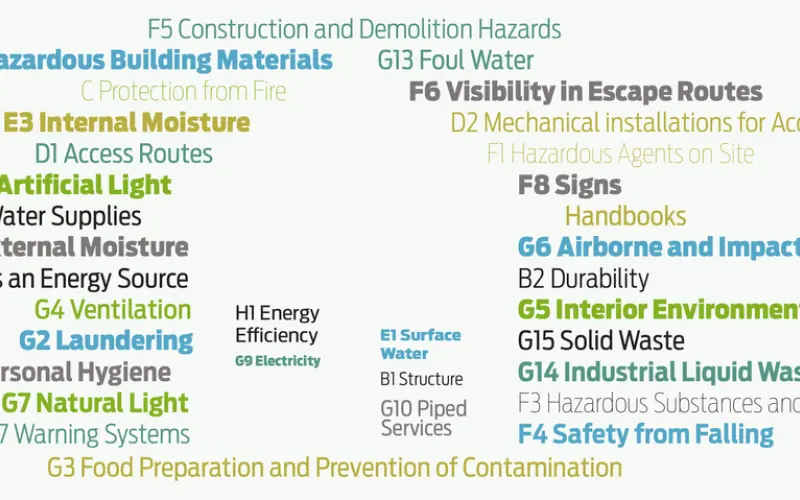
The performance-based New Zealand Building Code has 37 clauses and three preliminary clauses. These set out the functional requirements and performance criteria that the Building Act requires all buildings to meet. They do not prescribe how the work should be done.
To comply with the Building Code, building work has to satisfy the requirements set out in each of the Building Code clauses. Building Code clauses offer a Verification Method and/or an Acceptable Solution. Most have both.
Pathways to compliance that are deemed to comply with the Building Code clauses are:
- Verification Methods
- Acceptable Solutions
- determinations
- product certification (where the product use is within the scope of the product certification).
The primary certification systems include CodeMark, MultiProof, and BuiltReady.
Alternative Solutions
Sometimes a different building solution is needed. Proposed construction methods that are outside of, or a variation from the deemed-to-comply compliance paths of Acceptable Solutions and Verification Methods, need to be consented as an Alternative Solution.
Sufficient supporting evidence is needed for the building consent authority to determine on reasonable grounds that the proposed work will be Code compliant. Once consented, it becomes an Alternative Solution. Supporting evidence may be:
- a satisfactory history of use in a comparable situation
- a comparison to an Acceptable Solution
- a previously accepted comparable Alternative Solution
- independently assessed performance, such as a BRANZ Appraisal
- the subject of an expert opinion
- favourable test results that are relevant to the proposed use.
A good resource that explains Alternative Solutions, Verification Methods and compliance paths for Alternative Methods is BRANZ Building Basics Building Code Compliance.
Always use the latest version
All 37 Building Code clauses are available free from www.building.govt.nz/building-code-compliance. Acceptable Solutions and Verification methods are updated from time to time, so always check you are using the latest version.
Standard format for clauses
Each Building Code clause has a similar structure. As an example, let’s look at Building Code clause B1 Structure that covers Acceptable Solutions and Verification Methods for B1 Structure. In order, it contains:
- document status with the history of all document alterations
- relevant extract from the First Schedule of the Building Regulations 1992 with:
- objectives
- functional requirements
- performance requirements
- contents
- references indicating the versions of standards and other documents that apply to the Acceptable Solutions and Verification Methods and where in the Building Code clause they are quoted
- definitions
- Verification Methods that provide a means for the design of structures to meet the performance requirements of the Building Code – for example, B1/VM1 covers Verification Methods for general construction, referencing relevant standards
- Acceptable Solutions that provide either a specific deemed-to-comply solution or references standards that, if used as required, will meet the performance requirements of the Building Code – for example, B1/AS3 includes specific solutions for small chimneys.
Acceptable Solutions, Verification methods can modify standards
Cited standards can be modified by clauses within Acceptable Solutions and Verification Methods.
It’s always a good idea to check the current edition of the Acceptable Solution or Verification Method to see what edition of a standard is referenced, and whether or not they modify the standard.
For example, B1/AS1 references NZS 3604:2011 as an Acceptable Solution for timber-framed buildings, but with a number of modifications. For example, B1/AS1 at 2.3.3 requires the NZS 3604:2011 definition for ‘good ground’ to be amended to take account of liquefaction and lateral spread.
When an updated edition of a standard is published, the new edition is not automatically a means of compliance. An Acceptable Solution or Verification may still reference an earlier edition. Use of the updated (but not yet referenced) version of a standard will follow the path of an Alternative Solution.
Keep your standards current
A good method to keep your standards up to date is to look at the relevant Acceptable Solutions and Verification Method clauses, for example, B1/AS1 Structure when using NZS 3604:2011.
Check if amendments have been made to the standard or if a later version is referenced.
The side columns in the Building Code clauses always have the amendment number and date modified so the most recent changes can be tracked.
If a later version of the standard has been referenced without amendment, use the later version of the standard.