

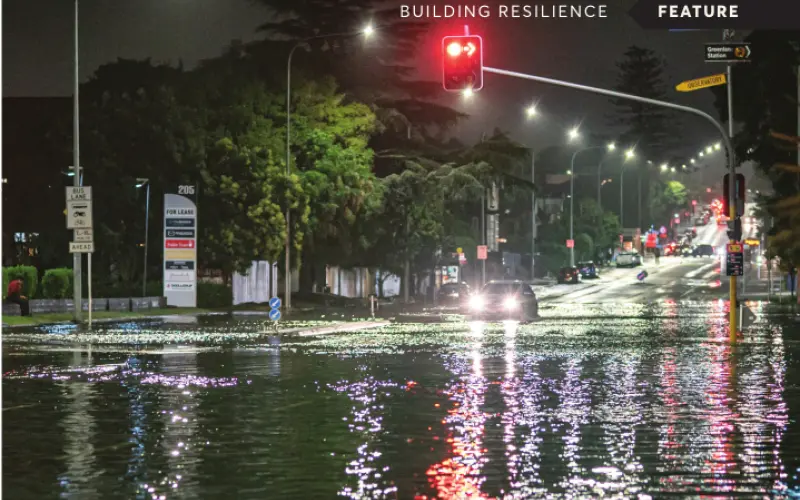


Following a disaster, there is often a need to look to government authorities to lead recovery and take overall responsibility for damage. However, it is not always clear to communities who is responsible for what. Researchers at Massey University, in collaboration with WSP, have been working on a project under the Resilience to Nature’s Challenges National Science Challenge to understand the difference between community needs and legislative provisions.
Henderson Valley as an example
The researchers used a case study approach examining the August 2021 Henderson Valley floods in Auckland. Henderson Valley is a semi-rural community on the border of Auckland and has frequent weather-induced flooding events. The 2021 event was one of the most severe.
Eight months post-disaster, the researchers examined community recovery and found that they were still recovering from floods and landslides that damaged houses, roads and bridges. A concern for the residents was that, as climate change continues to expose Aotearoa New Zealand communities to more frequent storms and floods, their community will need to decide how to manage their future.
Henderson Valley is vulnerable because of the location of community assets close to rivers, streams and floodplains. Vulnerable assets include commercial buildings and residential properties, communication systems, transportation, water, wastewater systems and energy systems.
The research examined communication challenges that arose from the impact of the floods and found that there is a difference between what the community expects and what is provided by recovery authorities. The research found that community resilience building assists with overall recovery but the difference between expectations and what is provided has implications for community recovery.
Recovery authorities’ responsibilities considered in the research were the National Emergency Management Agency (NEMA), Civil Defence Emergency Management (CDEM) groups, Auckland Council and Waitākere Ranges Local Board.
Community found to be well prepared
The researchers found that, because the community has been subject to frequent events, it had a good understanding of recovery planning and, generally, the community was well prepared. It had built strong social capital, there was a well-known Henderson Valley Residents’ Association, people knew their neighbours and there were frequent community engagement activities.
Most residents who answered the research questions were aware of a community-led disaster emergency plan. Residents said that the plan was distributed by the Henderson Valley Residents’ Association to the community via its Facebook page.
The research found that the flood-prone areas could be better communicated to the community. For instance, the place agreed by the residents for the community to congregate and triage issues appears to be in a flood-prone area. Council and community leaders need to agree on a more suitable place.
Communities unaware of some responsibilities
There was an expectation that communities were responsible for keeping waterways clear and clearing waterways post-disaster. This was not well understood.
According to Auckland Council, it is the responsibility of the owner of a watercourse on private land to ensure that:
- litter and pollutants do not enter the watercourse
- there are no obstructions or impediments to the flow of water
- grates or outlets within a property are kept clear from debris at all times.
However, some residents were not aware that clearing waterways was their responsibility and felt that clearing debris, including whole trees, was difficult for private individuals without heavy engineering equipment they did not possess.
Need better communication with authorities
The research showed there was a need for better communication between all agencies and the community, including councils. After the event, one resident said, ‘It would be good if insurance companies, the government and council would have been on the same page and the recovery process could be streamlined to help the community recover faster.’
To plan for effective recovery and build community resilience, communities need to know what to do, where to go and who to ask for help. Public policies need to be understood. Keeping the needs of the community at the centre of recovery planning involves the recovery authorities and local community building a relationship.
Often this is hard to achieve because the legislated responsibilities of the recovery authorities are not well communicated to or understood by communities, so when there is an event, there is a tendency to blame one another for deficiencies in recovery.
The community recognises the need for a better relationship with recovery authorities. One resident said, ‘Communication is key for recovering quickly after a disaster, and so I think there should be a lot of involvement with the council and the community, especially regarding sharing information on recovery planning.’
Councils also need to prioritise their relationships with the community to better build resilience.