

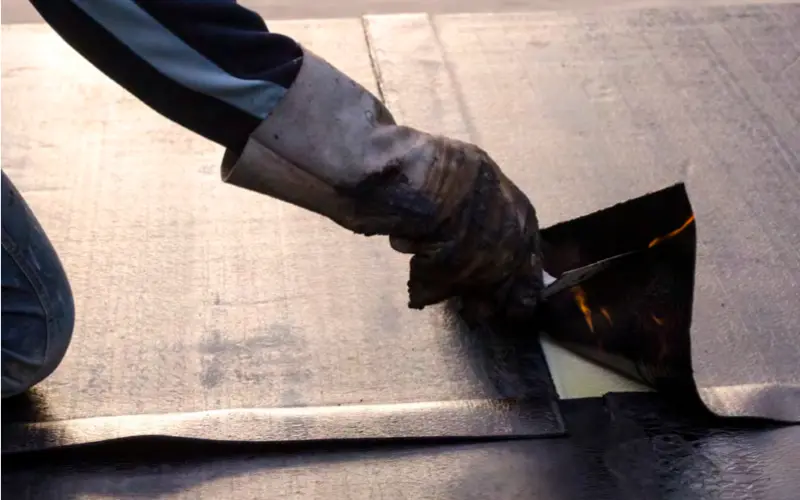


Rainwater caught by the balconies was directed by a slope back towards the building to a gutter cast into the concrete adjacent to the exterior wall. As some of the precast concrete balconies were too long to be craned into position in one piece, they included a join. All had a downpipe connection at one end of the gutter. A waterproofing membrane was bonded to the balcony, and acoustic matting and tiles were placed over that.
What went wrong?
The joints in some of the balconies were filled with grout and the downpipes were sealed to the concrete then a liquid membrane applied over the surface before acoustic matting and tiles were added. What could possibly go wrong?
Three things. Some of the joints were not fully filled with grout, leaving holes, some of the downpipes were not completely sealed to the concrete and the waterproofing was poorly applied with inadequate thickness, exposed reinforcing mesh and a few patches missed altogether.
As the gutter and downpipes were immediately adjacent to the exterior wall, water that was able to get through some of the joints and downpipes could get into the outside wall. The building had a good rainscreen cavity to protect the outside wall, so damage was limited to corrosion of cavity battens and a few isolated areas of damage to the exterior wall.
Claim made against builder
A claim was made in the High Court against the builder, the council and others involving a long list of defects. The claim was for repair costs of $60 million plus damages and consequential costs of about $7 million – significantly more than the original construction cost of the building. While the defects list had been reduced to only two by the time of the trial, the damages claimed remained much the same.
The builder claimed they were not responsible for the defects causing damage or potential future damage because the waterproofing and tiling were carried out by a subcontractor and inspected by the architect.
The builder said they had no duty to inspect the work of the subcontractor because the builder believed them to be competent and a specialist in waterproofing. The builder believed they could not be held responsible for the negligence of an independent subcontractor.
The law on this has been settled for some time. The claim was brought in negligence. The plaintiffs must establish on balance of probabilities that:
○ the defendants owe them a duty of care – they must be careful to comply with the Building Code and other standards and regulations
○ the duty was breached – they did not comply with the Building Code or other standards and regulations
○ the breach of duty caused damage
○ damage resulted in a loss to the plaintiffs.
Court established non-delegable duties
In 1996, the Privy Council established that builders and local authorities owe a duty of care to current and future owners of a building. However, the key issue here was whether the builder owed a non-delegable duty – meaning that they could be liable not only for their own work but also for breaches by independent contractors that they hire.
Non-delegable duties were established by the Court of Appeal in 1979. Whether a builder owes a non-delegable duty is specific to the facts of each case. It depends on the builder’s role and responsibilities on a particular project and whether the builder is the head contractor and in control of and supervising the work on site.
Builders’ duties have been defined in various cases over the last 20 years. Consideration is given to the contract that established the scope of the builder’s responsibility on the site, whether subcontractors were hired by and under the direct control of the builder as main contractor and the roles and responsibilities of other parties on the project.
For the establishment of a nondelegable duty, the builder must be in a position of significant control and have the capacity to influence the quality of the construction and compliance with the building consent and Building Code. The terms of the builder’s contract with subcontractors will also be important.
Builder had responsibility
Here, the builder was found to have a non-delegable duty and was responsible for the acts and omissions of the subcontracted waterproofer/tiler. The subcontractor was also responsible for their own acts or omissions but was not a party to the litigation, possibly because they were out of business.
Fortunately for the builder, the judge found that the remedial scope of work proposed by the owner’s experts was ‘a wholly disproportionate and unreasonable response to the defects for which the defendants might properly be held responsible’. Justice Andrew accepted the alternative repair method of the builder’s experts, resulting in a judgment of about $5 million – substantially less than the $60 million claimed. Auckland Council was found liable for a 15% contribution to the total judgment.
Waterproofing and tiling are risky
The message is clear for builders. You are responsible for the work of your subcontractors, and you should supervise and inspect their work. One of the highest risk trades in Aotearoa New Zealand is waterproofing. Inadequate waterproofing is a common defect in litigation over the last 25 years.
This builder was unfortunate because concrete balconies outside of the building are low-risk features that should not result in a significant problem. However, design decisions outside of the builder’s control contributed to an unusual situation. There are many more common risks with waterproofing that can cause very expensive repair works. The defects on this building were atypical.