



Aotearoa New Zealand needs fast and affordable construction that supports the transition to a zero-carbon built environment. As efforts increase to develop and construct innovative, resilient and high-performing buildings and building systems, it is also critical to ensure we are making progress in reducing greenhouse gas emissions from the built environment. It is a delicate balancing act between innovation that we can trust and environmental wellbeing – but one that is very significant for all of us.
Aim is to help with decision-making
Non-traditional building systems – a research project currently under way as part of the Transition to a zero-carbon built environment programme at BRANZ – seeks to provide an increased understanding of how to evaluate innovative and non-traditional building systems across a range of issues relevant to contemporary buildings.
The main aim is to support the use of construction technologies that meet both Aotearoa’s house construction and zero-carbon targets. The results will allow building sector stakeholders to make more informed decisions about different building systems that fall outside of what is currently considered typical or conventional.
The research project will include a review of current construction processes being used in Aotearoa as well as overseas. This international scan will help us to understand what construction processes are being used elsewhere and their relevance to Aotearoa in addition to what may be emerging soon. We are taking a systems approach to consider various aspects of construction processes, including the materials involved and their current and future supply and availability, manufacturing processes, skills required and consenting pathways.
What are non-traditional systems?
The term ‘non-traditional’ is not well defined. For this project, we consider those systems and methods not typically considered for most current building projects. Innovative and non-traditional building systems include not only the use of different materials that are usually included in building systems but also cover design, manufacturing and construction methods that have been used in other industries and are now being integrated within buildings.
Non-traditional construction systems can offer advantages in terms of speed of construction, quality and affordability. However, to be used successfully in Aotearoa, their performance within our resilience and environmental sustainability frameworks must be considered. Although it is important to know how these systems can be advantageous, it is also important to understand the implications of using them in terms of long-term performance and greenhouse gas emissions.
A significant shift within the building industry in recent years has included off-site manufacturing where building components are assembled in factories and are then delivered to site for fast and often efficient assembly. This tactic can significantly reduce construction time and save money.
Examples of this approach are often found for residential buildings using timber or steel framing where frame and truss manufacturing methods are employed. More recently, we are seeing more off-site manufacturing with linings, cladding and potentially windows, doors and services being included within panellised systems that can then be quickly assembled on site.
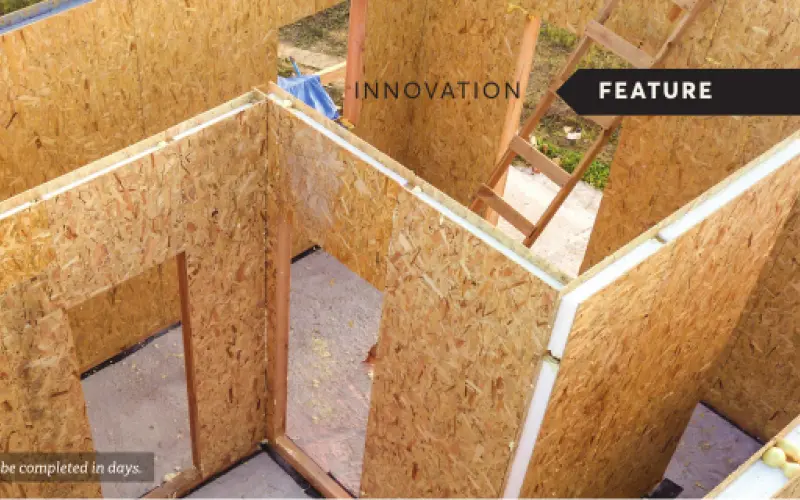
This can include systems like cross-laminated timber (CLT) and structural insulated panels (SIPs) as well as timber and steel-framed systems. In some cases, these panellised systems are used to create three-dimensional building modules so that, once a foundation is constructed, the modules are installed on site. A building can sometimes be completed in a matter of days. Other innovative examples include 3D printed concrete and interlocking frame systems using timber-based panels that can optimise the use of 1.2 x 2.4 m sheet products while minimising waste.
Design and manufacturing options
Beyond the systems used to construct buildings, there are also innovations for the design and manufacture of prefabricated building systems that should be considered when weighing up options for building. Digital technology is being used more frequently to streamline processes for off-site and on-site construction.
For prefabricated systems that can make use of high levels of manufacturing such as CLT and panellised framing systems, there are technologies that allow a project to go from the designer’s computer directly to the factory floor where components are assembled or machined with very high tolerances. This has opened the door for optimising material usage and assembling practices using design for manufacturing and assembly (DFMA) concepts that make the most of the available technologies from around the world.
Building information modelling (BIM) is also being implemented across the building sector to integrate design, manufacture, assembly and construction. BIM uses specialised software to model an entire building digitally and then optimises manufacturing and construction methods.
It is also useful for comparing different material options during the design stages and provides comprehensive data on the quantities of building materials required. This can be very helpful when determining greenhouse gas emissions for buildings and is needed when using LCAQuick, a life cycle assessment tool developed by BRANZ.
New and innovative construction processes can offer many advantages over traditional construction, but it can be complex to consider all necessary performance requirements of a system and to find that information easily.
Developing directory of different systems
An output of this project will be a directory that collates information on new construction systems and supports users to make informed decisions about the use of different systems. Users will be able to search different construction types and access key information about their environmental impacts as well as other resilience aspects.
The directory will provide links to other relevant information related to various systems and their use or potential use in Aotearoa. This could include data on structural performance, durability, fire resistance, weathertightness and life cycle assessment, where that information exists. The directory aims to be a user-friendly tool intended to inform and educate the industry, supporting evidence-based decision-making about the use of a variety of new construction opportunities.