



Global warming and the climate crisis are already affecting Aotearoa New Zealand and other parts of the world. To address this, two important concepts have emerged from the Climate Change Response (Zero Carbon) Amendment Act 2019 – adaptation and mitigation. Here, we address what these concepts mean and where New Zealand is currently placed in terms of putting together action plans to combat the adverse impacts arising from climate change.
The concept of adaptation
Adaptation can be described as the process by which we can alter our behaviours, systems and ways of life to adjust to the existing and future impacts of climate change. This includes reducing greenhouse gas emissions and constructing infrastructure and buildings that are more sustainable.
In 2022, New Zealand launched its first national adaptation plan (NAP) containing the government’s current efforts to help build climate resilience. The NAP sets out strategies and actions that MBIE plans to respond with to the disastrous events caused by increasing global temperatures. In relation to homes and buildings, the NAP’s approach focuses on two key principles:
- The right buildings – ensuring that building standards take into account our future climate – for example, wind pressures and rainfall intensity.
- In the right places – not building inappropriately in areas where climate change hazards are likely – for example, areas subject to flooding.
MBIE’s programme
MBIE is leading the building and construction sector’s response to climate change. One piece of work in progress encapsulating the two principles in the NAP is the Building for climate change programme, which is guiding the building and construction sector in achieving carbon emissions targets and ensuring our buildings are prepared for the future effects of climate change.
The programme ensures energy efficiency and carbon emissions core considerations and promotes building design and construction to use as little energy and water as practicable and to reuse buildings and recycle materials where possible.
Its long-term vision is to have Aotearoa’s building-related emissions at net zero by 2050.
The concept of mitigation
In comparison to adaptation, mitigation is human intervention to prevent or reduce the impacts of climate change by eliminating the release of greenhouse gas emissions.
As part of the mitigation strategy, the MBIE programme contains emissions reduction goals to reduce emissions from the energy used to operate a building and the carbon emitted from manufacture, transport, use and disposal of building materials and products.
The programme encapsulates three main ways in which Aotearoa is looking to reduce the whole-of-life embodied carbon – the emissions associated with the use of materials in the construction process:
- Improving new building efficacy – for example, ensuring buildings are climate resilient and that they are built to last.
- Improving material efficiency – designing smarter buildings that use less materials for the same functionality and performance, reducing waste at construction and demolition stages through reuse and recycling of materials.
- Reducing the carbon intensity – for example, using lower-carbon materials such as timber or reducing emissions from the manufacture of materials.
Raising awareness
The concepts of adaptation and mitigation and the Building for climate change programme challenge those in the industry to think about how to build infrastructure in a way that puts energy efficiency and emissions reduction at the forefront of building designs and processes.
It also demonstrates MBIE’s commitment to adapting the built environment to withstand the changing environmental conditions that climate change has caused and will continue to cause as well as to come up with ways the industry can reduce its carbon footprint.
However, for the industry to transform, all parties in the sector – and ultimately including the consumer – must be aware of MBIE’s programme and its objectives. They will also need to be aware of newly introduced building regulations that will arise in the future to adapt and reduce our carbon emissions as well as have an intention to comply with them.
Stormwater management – an adaptation solution
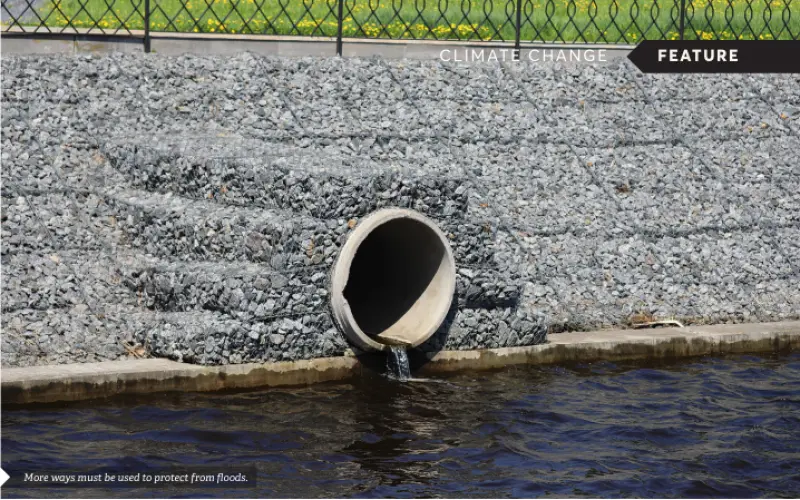
Recent weather events illustrate why New Zealand’s building stock must adapt to the changing environmental conditions. The use of detention tanks is an adaptation method that is already being adopted to prevent flooding and will likely become more common in the future.
These tanks are designed and used to temporarily hold rainwater and excess stormwater run-off and then discharge it to the existing stormwater system at a much lower rate compatible with the capacity of the stormwater system. Detaining water means there will not be a sudden surge of excess water downstream that will cause flooding.
Although detention tanks are encouraged, they do not appear to be mandated in high flood risk zones in New Zealand. In the future, local councils may make installation of these tanks compulsory to ensure effective adaptation to cope with adverse events caused by climate change and housing intensification.