



Based on a strong commitment to New Zealand’s Climate Change Response (Zero Carbon) Amendment Act 2019 and its intention to help the country reduce its greenhouse gas (GHG) emissions under the Paris Agreement, the concrete industry is determined to reduce its GHG emissions to net-zero by 2050.
Why concrete is vital
Concrete will play an integral role in both mitigating and adapting to the effects of climate change, supporting sustainable and resilient communities around the world, including Aotearoa. Concrete is the essential building material that has shaped modern society, and it is vital for building a more sustainable future.
It will help to create and maintain thriving communities by delivering infrastructure, homes, clean water and clean and renewable energy and by providing a more resilient built environment as our climate changes.
2050 net-zero carbon roadmap
Concrete NZ’s members have committed to producing carbon-zero concrete by 2050 in line with global climate targets. The recently released roadmap sets out a plan for how the industry will achieve this goal and play a major role in building the sustainable world of tomorrow.
In short, the roadmap describes an achievable pathway to producing net-zero concrete by 2050 that works for the Aotearoa industry.
Key roadmap stakeholders
Covering both ready-mixed concrete and concrete products, the roadmap builds on past and current initiatives and involves the major parties in the concrete value chain, including:
- cement manufacturers
- concrete producers
- manufacturers of concrete products
- designers of buildings and infrastructure
- construction companies and contractors.
Developed with support from sustainability strategist thinkstep-anz, the roadmap also involved engagement with Concrete NZ’s Cement, Masonry, Precast and Readymix sector groups as well as its Learned Society.
Funding was received from BRANZ via the Building Research Levy and from MBIE’s Building Innovation Partnership administered through the University of Canterbury.
Targets for 2030 and 2050
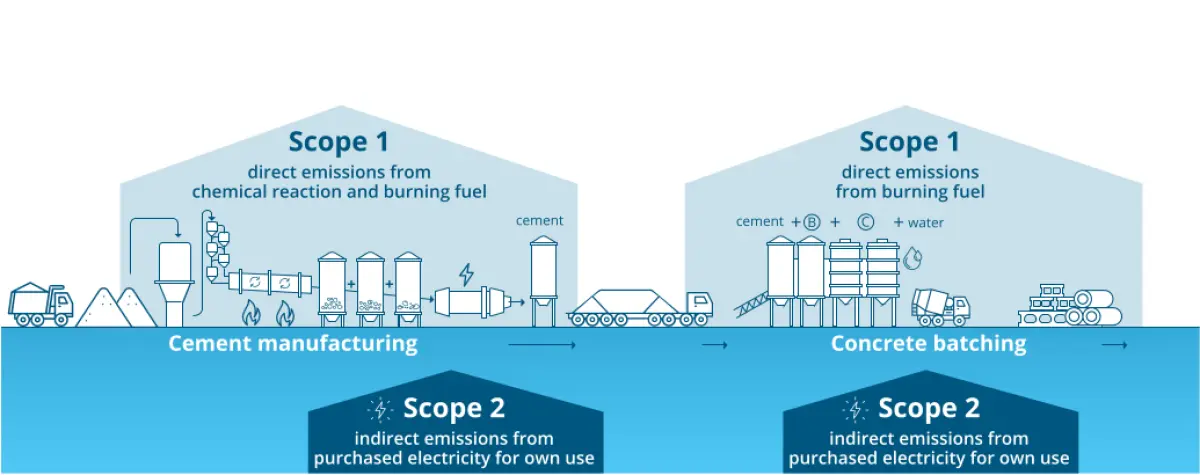
The roadmap identifies ways to reduce the direct (Scope 1) and electricity-related (Scope 2) GHG industry emissions by 44% from 2020 levels by 2030 and 100% by 2050.
The 2020 reference year was chosen to align with the Global Cement and Concrete Association (GCCA) Cement and Concrete Industry Roadmap for Net-Zero Concrete.
In addition, the focus on Scope 1 and Scope 2 emissions, where the industry has direct influence, aligns with the GCCA’s global roadmap and those from other nations.
Figure 1 illustrates Scope 1 and Scope 2 emissions in the cement and concrete manufacturing process. If indirect (Scope 3) emissions are included to align with an environmental product declaration approach, the 2030 reduction target would drop from 44% to 29%. Figure 2 shows the pathways or levers the industry will take to achieve its emissions-reduction targets.
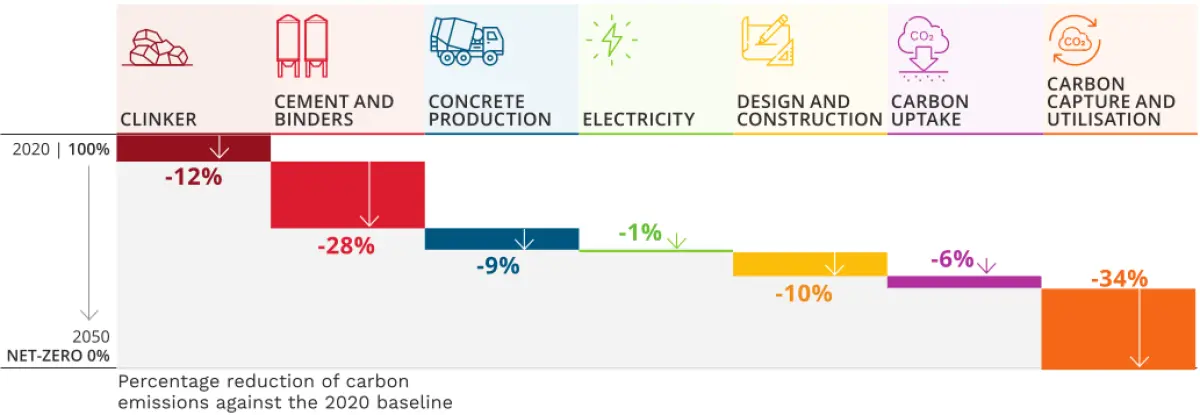
Manufacturing Portland cement releases CO₂ directly through a chemical reaction, which results in a major share of the industry’s total emissions. Burning coal in clinker production is the other main source of emissions.
Until 2030, the industry will reduce emissions by using alternative fuels in clinker production and increasing the use of mineral additions such as ground limestone and supplementary cementitious materials (SCMs), which are mineral byproducts of industrial processes with lower embodied carbon than cement. The industry in Aotearoa has used SCMs before, but there is scope for growth and greater volumes are now entering the market.
Between 2030 and 2050, the industry will focus on further significant reductions in GHG emissions in cement manufacture and plans to use a technology known as carbon capture, utilisation and storage (CCUS) to capture any remaining emissions. Further CO₂ will be absorbed naturally by concrete as it ages through a carbon-uptake process called recarbonation.
We also expect that improving efficiency in the design of buildings and infrastructure will make an important difference, while additional small savings will come from decarbonisation of the electricity grid.
Continued successful reduction of the industry’s emissions will rely on further research and development, investment and commitment from the government and other stakeholders throughout the value chain.
The industry intends to review the roadmap annually and report on progress across the pathways every 5 years. This will ensure new technologies and innovations as well as regulatory and other changes are reflected in the proposed pathways.