




New Zealand building code clause D1 Access routes requires that people with disabilities can enter buildings and carry out normal activities within the building. Acceptable Solution D1/AS1 provides the means of compliance.
D1.3.2 says that ‘at least one access route shall have features to enable people with disabilities to … approach the building from the street boundary … [and] have access …’.
However, the Building Act also states that the performance requirement of D1.3.2 does not apply to private houses, apartments and small industrial buildings. Nevertheless, D1/AS1 provides guidelines for accessible design of outdoor spaces that can be usefully followed for residential dwellings.
Access to public buildings
D1/AS1 cites NZS 4121:2001 Design for access and mobility – Buildings and associated facilities, which provides additional accessible design detail.
An accessible route is from a car park, drop-off point or street boundary to the main entry into a building. It may include vehicle access and space to manoeuvre, car parking, paths, ramps, stairs, decks and the building entrance.
Sufficient space is needed for vehicle access and circulation. NZS 4121:2001 sets out how many car parks must be provided for people with disabilities and the dimensions of the car parks for particular buildings.
The design of ramps and kerb ramps needs to include gradient, width, upstands, surface finish, landings, barriers and handrails. Kerb ramps to vehicle crossings need tactile indicators. Stair design must consider tread and riser dimensions, width, surface finish, landings, barriers and handrails.
Entry into the building should have a level threshold and, where required, a slope or ramp.
Accessible route requirements
Accessible routes are required to have:
- a sealed, slip-resistant surface with any butted pavers laid even
- a minimum clear width of 1,200 mm
- a transverse gradient of no more than 1:50
- openings between bollards and similar barriers wide enough for wheelchairs and guide dog users. Barriers should visually contrast with the background to assist visually impaired pedestrians.
Ramps on accessible routes must have:
- a maximum gradient of 1:12
- a maximum rise between landings of 750 mm
- an upstand of at least 75 mm where there is a drop-off side
- level landings at both top and bottom
- handrails on both sides and around landings.
Where a person can fall 1 m or more, a barrier is needed that complies with Building Code clause F4 Safety from falling and a handrail between 900–1,000 mm high.
Residential building access
Although the legislation governing accessible routes does not apply to residential dwellings, where possible, the guidelines provided by D1/AS1 and NZS 4121:2001 should be followed.
Vehicle access, car parking and garages
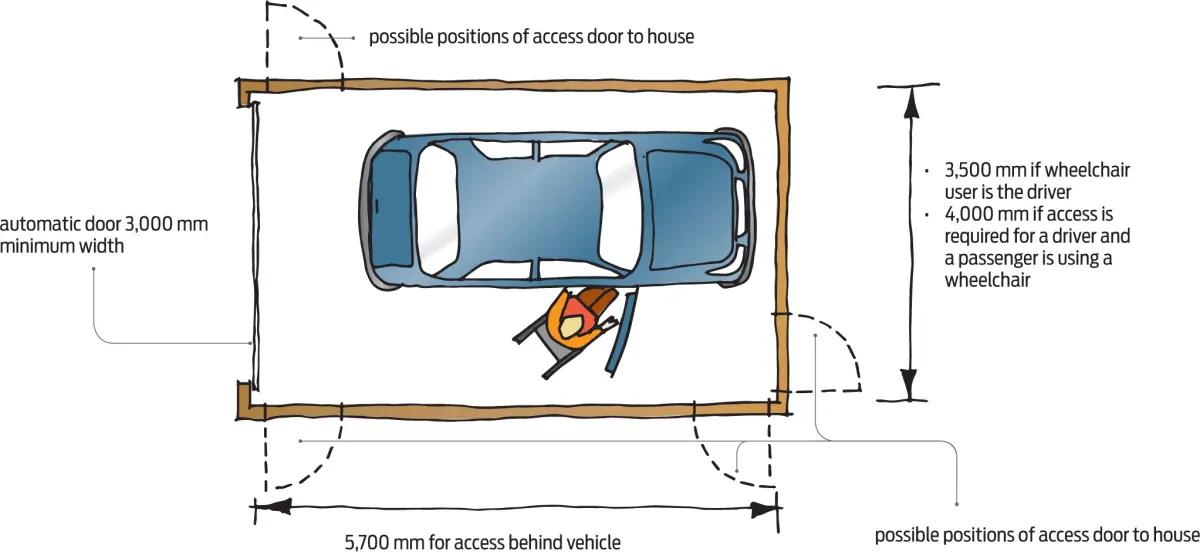
People with disabilities can often drive, so they need vehicle access and car parking up to the house. There are no special driveway requirements, but it’s recommended that parking areas are 3.5 m wide for wheelchair users and 3 m wide for ambulant disabled people.
If possible, a garage should have direct access into the house to provide:
- shelter
- security
- storage and battery recharging space for electric mobility scooters.
The garage should also be wide enough for a wheelchair user to get in and out of the car (see Figure 1). Access between the garage and house should be either level or ramped. An automatic door opener makes access easier.
Paths, ramps and stairs
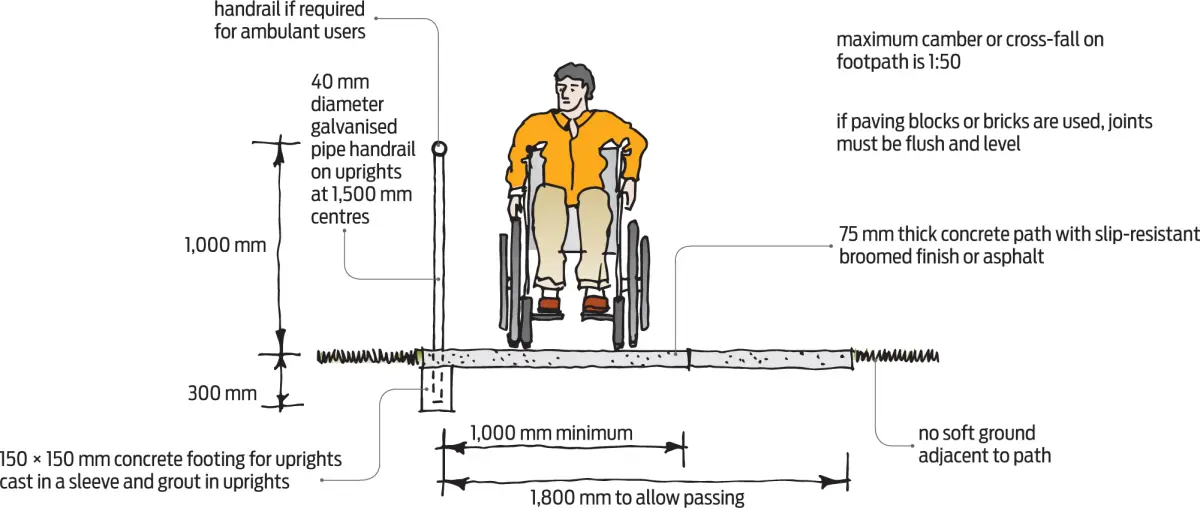
The access path should have as few steps and changes of level as possible. Where a change in level can’t be avoided, construct a sloping path or ramp with a gradient of no more than 1:12 – a gradient of between 1:15 and 1:20 is preferred.
Paths and ramps should preferably be at least 1,200 mm wide to allow space for someone to walk beside and assist a person with a disability (see Figure 2). They should have a non-slip surface and no obstacles. If paved, the joints between pavers should be flush and even. Ramps should also have either a minimum 75 mm upstand or an edge rail that is no more than 75 mm above the ramp.
Provide handrails between 900–1,000 mm high for safety or as an aid to walking. Where a person can fall 1 m or more from a footpath, ramp or landing, a barrier complying with Building Code Acceptable Solution F4/AS1 must also be provided.
Level entry to the house
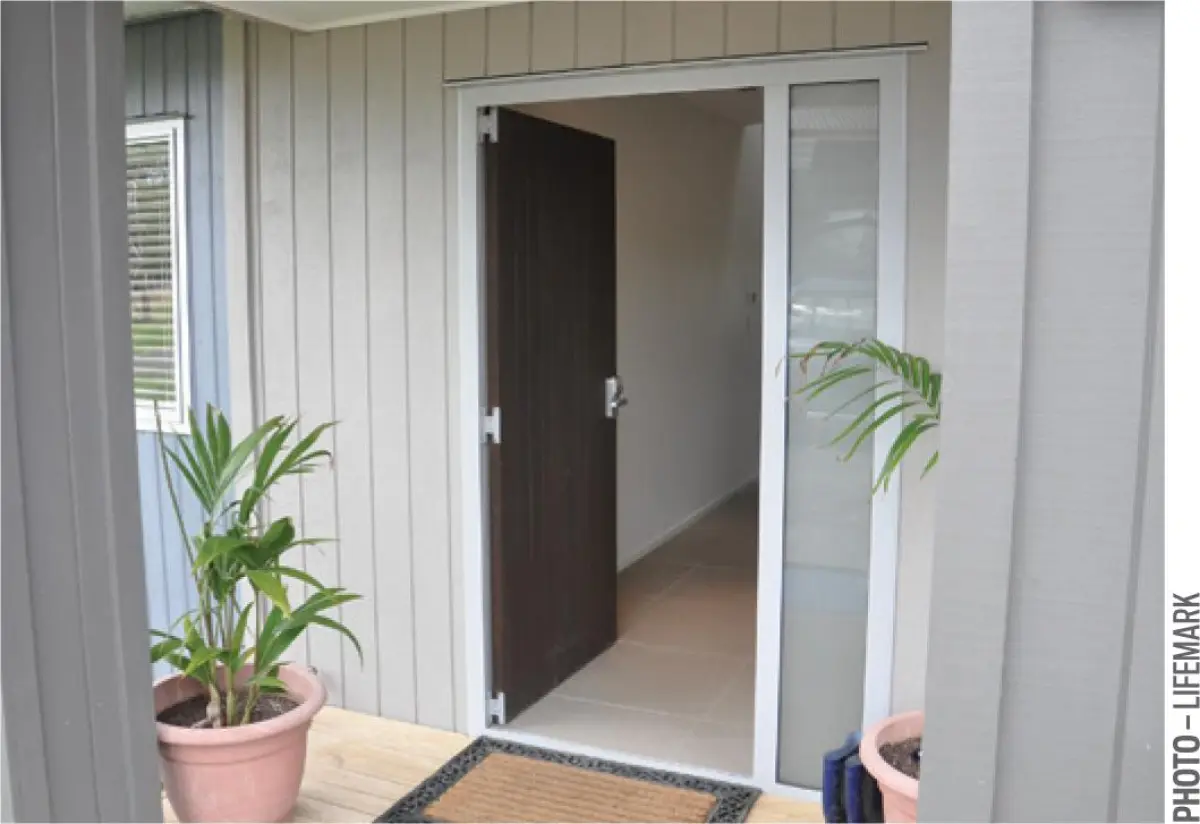
Entry into the house should be level (see Figure 3). This may require careful design and construction to prevent moisture ingress.
Concrete slab floors must be at least 150 mm above permanent paving and 225 mm above unpaved ground, while suspended timber floors are likely to be at least 400 mm above ground. Nevertheless, Acceptable Solution E2/AS1 allows level access in accordance with paragraph 7.3 and Figures 17A and 17B.
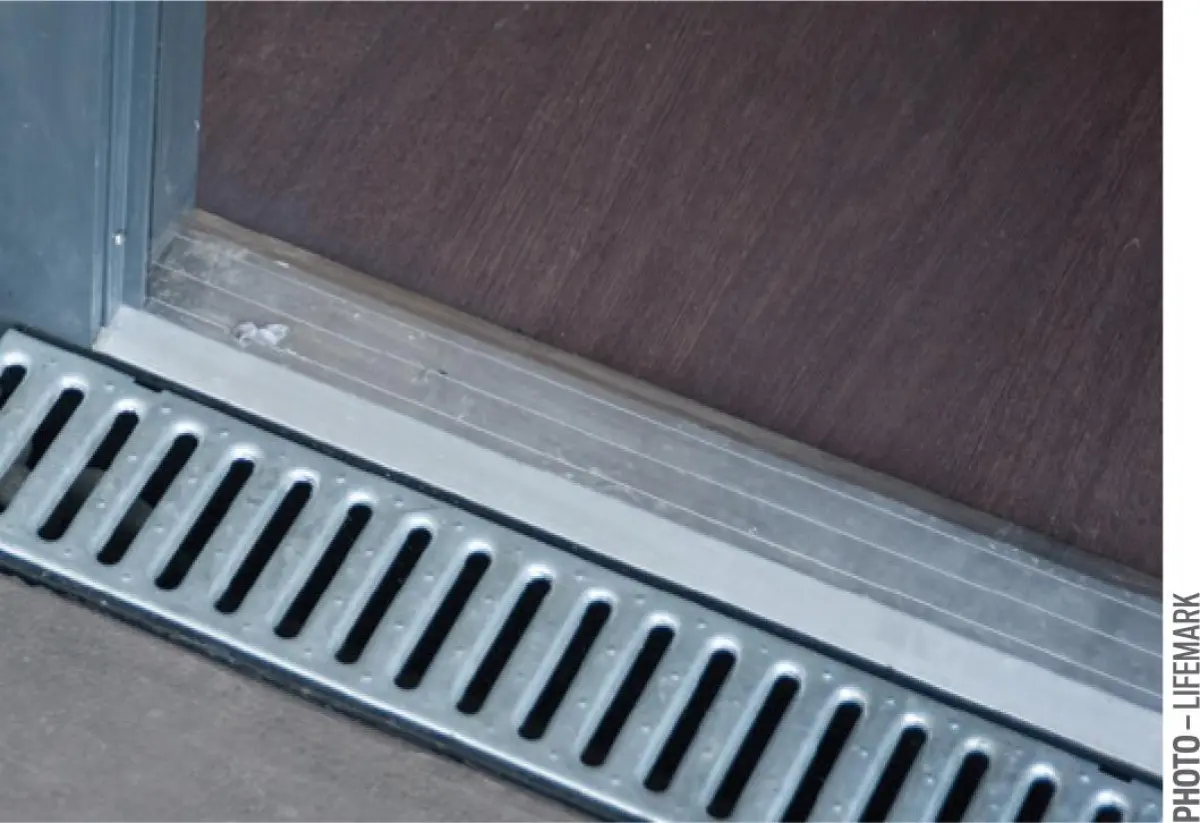
A concrete floor slab must have a drainage channel located across the door opening (see Figures 4 and 5) that:
- is wide enough to meet the surface water capacity requirements in E1/AS1 paragraph 3.2 for specific design
- under E2/AS1 is at least 150 mm deep
- is no more than 3.7 m long
- has a minimum 1:200 fall to a drainage outlet
- has a removable grating with gaps that cannot trap wheelchair wheels and mobility aids
- has a continuous 12 mm gap between grating and threshold.
Exterior drainage must comply with E2/AS1 including a minimum 1:40 fall away from the channel.
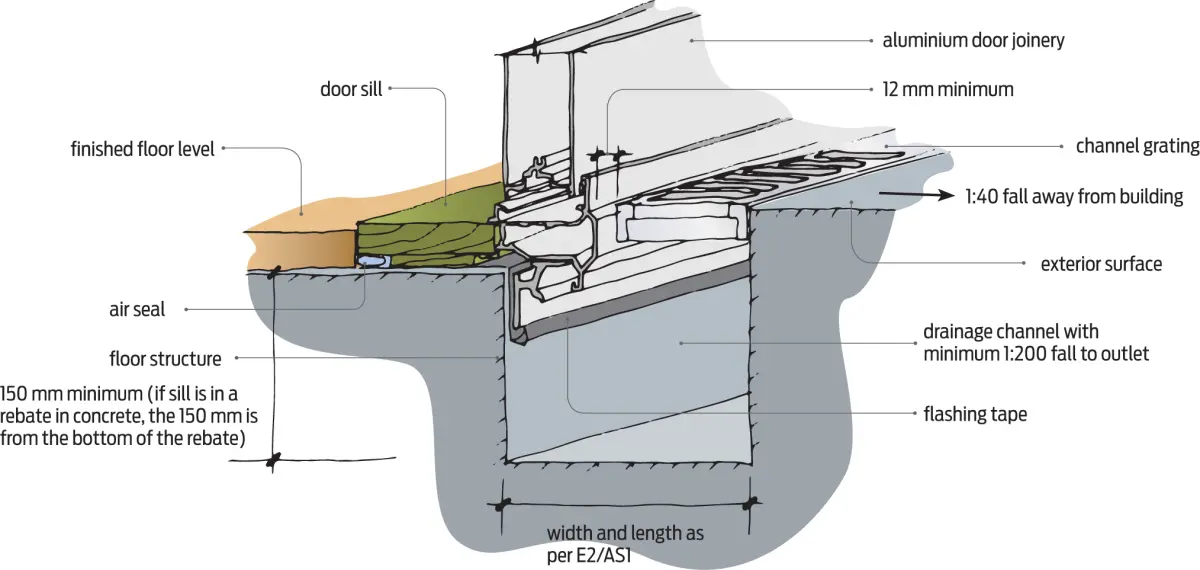
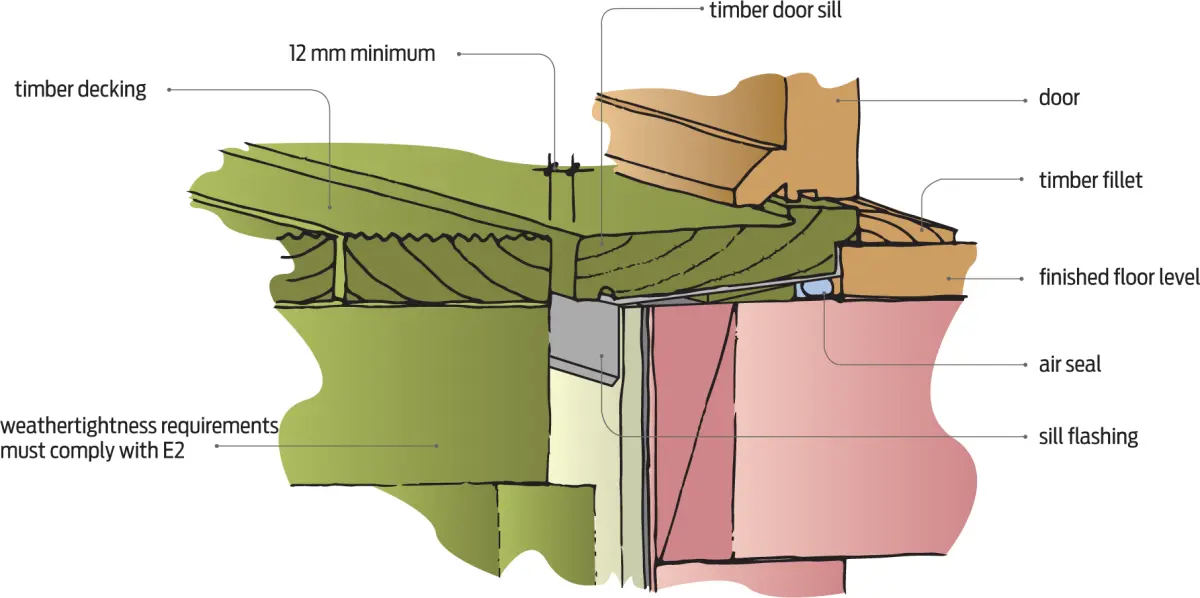
A timber floor may have a timber deck with level access. It must have a continuous 12 mm minimum wide gap between the decking and the threshold or doorsill. All weathertightness requirements of the opening must comply with clause E2 External moisture as shown in E2/AS1 (see Figure 6).
A non-cantilevered deck may be at the same level as the threshold in accordance with E2/AS1 paragraph 7.3 and Figure 17A. It must also have a continuous 12 mm minimum wide gap between the decking and the external wall. If the deck is enclosed, the underlying membrane plus removable surface of tiles, pavers or timber decking should be as shown in E2/AS1.
Roof the entrance to provide shelter. It should also be well lit at night, preferably with a sensor light. Provide sufficient manoeuvring room for a wheelchair.
Accessible mailboxes
Locate mailboxes so a driver can pick up the contents through the car window and a wheelchair user or ambulant person has easy access.
For more, See www.branz.co.nz/universal-design. NZS 4121:2001 Design for access and mobility – Buildings and associated facilities is available from www.standards.co.nz.