



Uncertainty dominated 2023, beginning with extreme flooding that led to worries around what would happen to flood-damaged properties and who would pay (see Disasters and densification on pages 62-63).
While discussions on this continued for the rest of the year, there were also uncertainties around the election and potential post-election changes to resource management law, the three waters programme and the Medium Density Residential Standards.
New government, new changes
The previous Labour Government intended to repeal the Resource Management Act and replace it with three new laws. It managed to get two of them – the Natural and Built Environment Act and the Spatial Planning Act – into law in August 2023. The third, a proposed Climate Adaptation Act addressing managed retreat from areas at risk of flooding and sea-level rise and funding adaptation, never reached Parliament.
In August 2023, the Labour Government put in place laws setting up its three waters programme (an amendment to the Water Services Entities Act, the Water Services Legislation Act and the Water Services Economic Efficiency and Consumer Protection Act).
Following the election, the new Coalition Government said that it would repeal the Natural and Built Environment Act and the Spatial Planning Act and amend the Resource Management Act to make it easier to consent new infrastructure and get more houses built.
The new government has said that it would make the Medium Density Residential Standards (MDRS) optional for councils. Under the MDRS, which had originally become law with multi-party support, up to three units and three storeys can be built on most Tier 1 council sites without the need for a land use resource consent.
Building product information
One law change was implemented without a fight at the very end of 2023 when the Building (Building Product Information Requirements) Regulations 2022 came into effect on 11 December.
This makes online publication of certain product information mandatory. The information includes:
- name, description and intended use of the product
- product identifier
- legal and trading names of the manufacturer or importer
- Building Code clauses applicable and how the product will contribute to compliance design, installation and maintenance requirements
- whether or not the product is subject to warnings or bans.
Other law changes
An amendment to the Construction Contracts Act 2002 helps subcontractors get paid if the head contractor goes under. Retention money is deemed to be trust property and must be deposited into a bank account meeting certain requirements.
An amendment to the Local Government Official Information and Meetings Act 1987 requires (from 2025) that regional councils share with city and district councils information they have on natural hazards. Councils must add ‘understandable information’ on natural hazards to LIMs.
Building Code compliance updates
For most of 2023, the focus of Building Code updates was the staggered implementation of the H1 Energy efficiency update. The 5th edition amendment 1 of H1/AS1 and H1/VM1 replaced the 4th edition on 3 November 2022, but the new minimum requirements for floor, wall and roof insulation in building consent applications for housing did not come into effect until 1 May 2023.
The final implementation step (doors and windows in housing in H1 climate zones 1 and 2) came into effect on 2 November 2023. That same day, MBIE published new updates to Acceptable Solutions and Verification Methods, largely covering protection from fire and plumbing and drainage:
- B1/VM1 no longer gives hollow-core floor systems a deemed-to-comply pathway.
- C/AS1, C/AS2, C/VM1, C/VM2 and F7/AS1 improve the safety of people from fire.
Interconnected smoke alarms are the minimum fire safety system in new household units, citing NZS 4514:2021 Interconnected smoke alarms for houses for installation. A 1 year transition period ends in November 2024.
- Acceptable Solutions for E1, G12 and G13 cite the 2021 version of AS/NZ 3500.
- G12/AS1 limits the lead content in plumbing products, with a transition period to 1 September 2025.
- Under G12 compliance, maximum hot water temperature delivered at personal hygiene fixtures in housing and certain other types of building was reduced from 55°C to 50°C. A 12-month transition period ends in November 2024.
- G12/AS3 cites AS/NZS 3500.1:2021 Plumbing and drainage – Water services and AS/ NZS 3500.4:2021 Plumbing and drainage – Heated water services for demonstrating compliance.
Standards changes
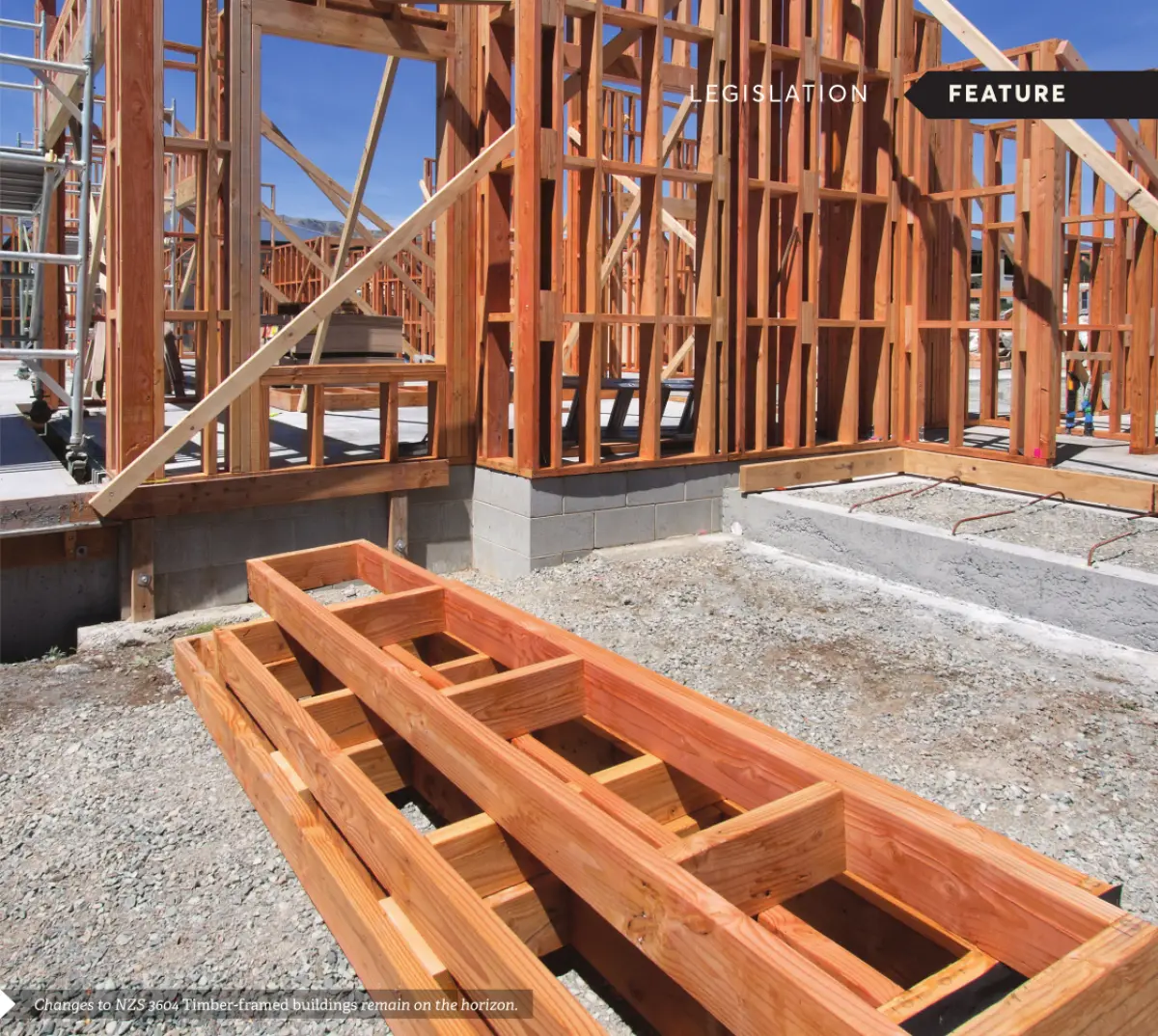
The biggest potential change – an updated NZS 3604 Timber-framed houses – remained a work in progress in 2023.
In the early stages of planning the update (in 2020), it was hoped that the revision would be published by late 2023, but that didn’t happen.
In December 2023, NZS 3910:2023 Conditions of contract for building and civil engineering construction was published, accounting for requirements in the Construction Contracts Act 2002.
Changes still in the works
MBIE is looking to change regulations covering licensed building practitioners (LBPs), plumbers, gasfitters and drainlayers, electrical workers and registered architects. Updates may cover licensing and supervision areas for the LBP regime and codes of ethics for plumbers, gasfitters and drainlayers and electrical workers.
In 2023, MBIE released a paper on potential changes to the building consent system. Topics include encouraging competition, removing blocks to product substitution and variations and new assurance pathways.
MBIE released a paper in 2023 and sought feedback on proposals to increase the Building Levy threshold from $20,444 to $65,000 and reduce the rate from $1.75 to $1.48 (including GST) per $1,000.
An independent panel set up by the government in 2021 to advise on local government reforms published its final report. The government published a Proposed National Policy Statement for Natural Hazard Decision-making to direct how decision makers consider natural hazard risk in planning decisions relating to all new developments.
A few things were pushed out
A number of initiatives originally planned for 2023 didn’t progress. They include:
- a consultation on proposed changes to building standards following updates to the National Seismic Hazard Model
- a change in law to make a waste minimisation plan mandatory for certain building or demolition work and make energy performance ratings mandatory for large new and existing public, industrial and apartment buildings. (The changes would be phased in over time.)
Some city councils won government agreement to delay implementation of the MDRS. Auckland City was allowed a 12-month extension to assess the impact of floods, and for Hamilton City, a deadline of 31 March 2024 was pushed to 20 December 2024 to allow continued work on flood mapping.
On the horizon
A few upcoming changes sound relatively minor but could have a big financial impact on some operations.
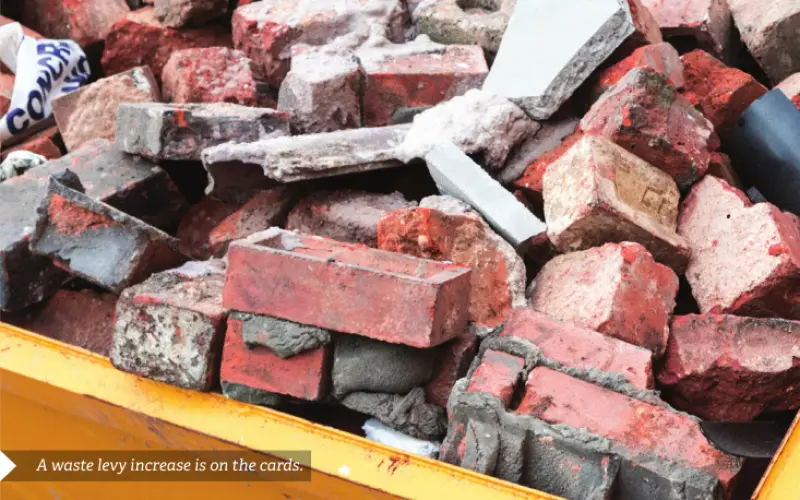
One is a proposed waste levy increase from $20 to $30 per tonne for construction and demolition fill (class 2) and from $50 to $60 per tonne for municipal landfill (class 1), with the rises due on 1 July 2024. In 2023, a $10 per tonne charge was introduced for managed or controlled fill facilities class 3 and 4, and there was a rise from $30 to $50 per tonne for municipal landfill (class 1).
MBIE has indicated that, in 2024, it intends to consult on plans for the measurement of greenhouse gas emissions in new buildings to be required in building consent applications in future years.
Groundwork for this appeared in 2023 when MBIE published a method for calculating the operational efficiency of a new building – a necessary step towards measuring and then reducing carbon emissions from energy and water use in buildings.