

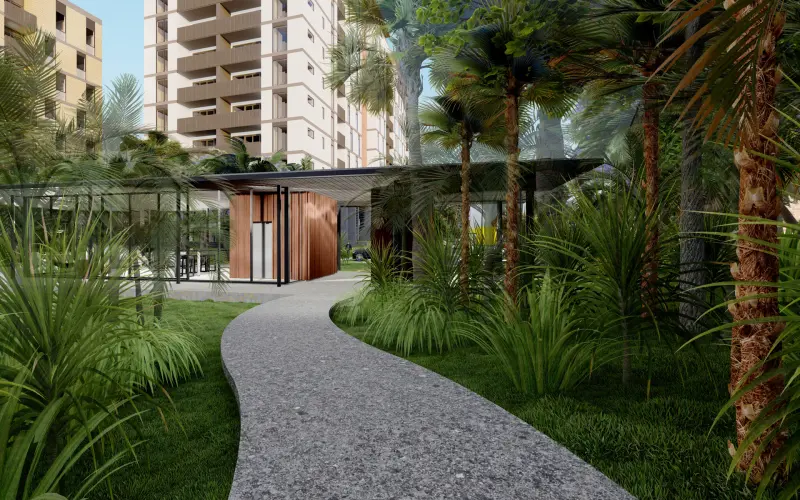


Earlier this year, Simplicity announced Te Reiputa, a housing development of 297 new one, two and three-bedroom apartments in Mt Wellington, Auckland. The build-to-rent project was the latest in a string of new developments by the not-for-profit KiwiSaver company’s homebuilding spin off Simplicity Living.
Half the cost
By itself, the announcement would barely warrant attention, but Simplicity Living has begun to attract attention – first, for the sheer number of homes it has in the works. Te Reiputa, a significant development in its own right, was one of no less than six similar build-to-rent projects announced by the company in 2023 alone.
Second is how quickly and costeffectively the homes are going up. Simplicity Living’s development in Auckland’s Point England took just 2.5 days per unit to construct, with each two or three-bedroom home costing in the ballpark of $450,000 including GST to design, consent and build – less than half the cost of orthodox apartment complexes.
Aligned goals in housing
Simplicity Living is the brainchild of Simplicity co-founder Sam Stubbs and NZ Living founders Shane and Anna Brealey.
In the years prior, Shane Brealey and NZ Living had put up more than 700 new KiwiBuild and market homes, which at the time made the husband-and-wife team the largest deliverer of KiwiBuild houses in the country.
A qualified civil engineer by trade, the experience helped Brealey hone a different approach to the design and construction of medium to large-scale projects. Despite its earlier successes, he felt his method had even greater potential to make Aotearoa housing more affordable, so he approached Stubbs with an idea.
The proposal was straightforward – Brealey would bring the building know-how and Stubbs the capital to scale it up. The pair struck a deal whereby the Brealeys gifted their company and its construction system to Simplicity and agreed to work for a new venture – Simplicity Living – for free for 10 years, building its portfolio of new build-to-rent properties.
Disruptive targets
Part of their agreement stipulates that the homes are not sold for profit. They must remain long-term rental assets owned by Simplicity KiwiSaver, generating income and capital gains for its investors. Simplicity Living would build, lease and manage the properties on its behalf.
They set an initial target to build and operate 10,000 rental properties across Aotearoa within the Brealeys’ 10-year window. Stubbs is on record saying he’d ultimately like to see one in 10 New Zealanders living in a Simplicity property.
From the outset, the pair rejected the short-term tenancy model that’s prevalent in Aotearoa. They want to attract much longer-term tenants, even entertaining the idea of intergenerational tenancies with right-to-occupy agreements. The idea is to provide stability and continuity to renters in Aotearoa in the same way long-term rentals do overseas.
‘We’re designing and building these things to last more than a hundred years because we intend to own them for more than a hundred years,’ says Brealey.
Position of power
Being design manager, developer, builder, owner, property manager and resident manager all rolled into one puts Simplicity in a unique position. Brealey says it can take advantage of vertical integration and gain enormous control over the design and construction process.
Brealey’s methods are no secret – he’s happy to share his ideas, provided it’s used for the betterment of New Zealanders.
Simplicity Living has just 14 employees, a team he mostly brought with him from NZ Living. He doesn’t engage external project or development managers and retains a handful of design consultants who ‘get it’, opting instead to keep all design and construction management, as well as carpentry and concrete work, in house.
The speed and cost advantages come, in part, from his embracing of standardisation, which he sees as the road to efficiency and quality.
‘We don’t do bespoke, we take a systems approach. That’s at the heart of everything we do, be it management, design or construction,’ Brealey says.
Standardise everything
Simplicity Living has two basic construction typologies – a 3-storey walk-up and a high-rise up to around 12 storeys. Every development follows the same basic blueprint and construction methodology.
He says that just because it’s possible to draw something doesn’t mean it can be built efficiently or that the customer should have to pay for it. Mandating a simple design with fewer drawings has led to faster builds, improved productivity and consistently higher quality because there aren’t any surprises in the design waiting for their team. Simplicity Living’s developments use repeated design elements – for instance, there are only nine kitchen designs and 16 window types across all its sites. Critics argue that the result is a cookie-cutter design – bland and unimaginative.
But Brealey is quick to dismiss such thinking.
‘Occupants couldn’t give a damn if their kitchen isn’t a custom job or their windows look the same as the apartments up the street. They just want a high-quality, warm, dry and affordable home for the long term,’ he says.
‘All the best residential developers in Europe and the US standardise their components, and they certainly don’t look bland or uninteresting. It’s only here in New Zealand that we like to criticise and label it cookie cutter.’ He speculates that this might explain why Aotearoa is one of the most expensive countries in the world to build and experiences poor-quality outcomes.
Construction methodology
Brealey’s construction method is similarly trimmed down, reminiscent of the Toyota Way, a lean manufacturing process of which he is a big fan.
The method emphasises efficiency and concurrency. If the site requires a piling system, that goes in first, followed by pouring a raft slab. Once the ground floor component is complete, the remainder of the structure goes up using a combination of in situ concrete walls and slabs.
The concrete system is the team’s own innovation – a technique called stack cell. It provides all the fire rating, bracing, structural and acoustic requirements for the build. He says it’s faster, cheaper and more robust than the precast concrete, steel, timber and block systems it replaces.
The system takes around 3–4 weeks per floor to construct, meaning a 12-storey apartment building comes in around 42–45 weeks. However, the key is that, two floors below the leading edge, the structure is fully watertight once the windows go in. That means the lower level fit-out can be complete long before the last upper-level concrete is poured.
Brealey says it’s like completing two projects simultaneously – the structure and the fit-out – or three if you count the external façade, which also follows closely behind the leading edge. The concurrency shaves up to a third off the project duration.
The façade is standardised 70 mm solid brick over a 50 mm cavity, which he says was chosen, like everything else, for its high durability, low maintenance and timeless appeal.
‘We’re deeply concerned about making sure everything is the absolute best we can do, because all these benefits, all the construction efficiencies, productivity gains, quality and durability gains and everything else will be captured and made available to New Zealanders for a century or more.‘