



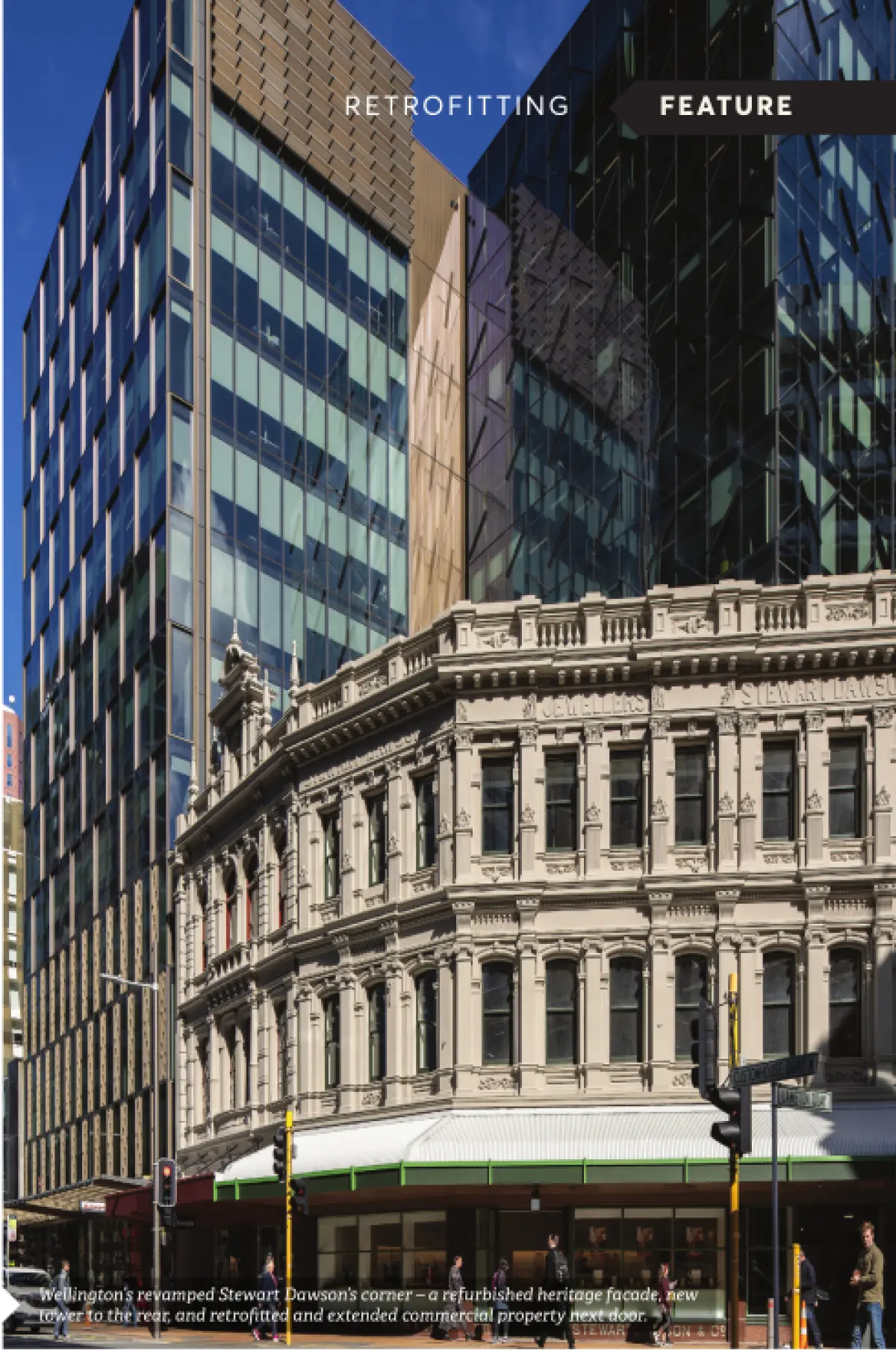
Chances are, if you’ve ever visited Wellington, you’ve been past Stewart Dawson’s corner. Located at the heart of the city’s golden mile where Lambton Quay and Willis Street meet, the site averages more than 4,000 pedestrians per hour. It’s one of the most desirable retail and business locations in the country.
Ahead of its time
It’s also the site of a heritage listed building designed in the classic Edwardian style by prominent Wellington architect William Chatfield and constructed around 123 years ago. The building’s engineering was advanced for the day, including a frame of steel stanchions and girders cast in concrete – a design intended to stand up to Wellington’s seismically active reputation.
Nevertheless, time and standards move on, and in 2016, MBIE listed Stewart Dawson’s corner as earthquake prone due, at least in part, to its unreinforced masonry façade above one of the busiest pedestrian thoroughfares in the country.
The building owner, Argosy Property, initially planned to refurbish the site by strengthening the façade and raising the structure to the level of nearby Boulcott Street. However, big tenants demand big spaces, and Argosy expanded its brief to include an entirely new multi-storey building behind the heritage structure and encompass the retrofit of their neighbouring property at 8 Willis Street.
Redesign, refurbish, retrofit
Despite the name, Stewart Dawson’s corner comprises three adjacent buildings, each named for its significant historical occupants – City Meats (originally the Fletchers Building designed by Thomas Turnbull and Sons), Stewart Dawson, and the United Fruit Company (originally the Equitable Building).
Each building has its own Category II listed façade concealing three individual roofs behind the parapets. The first and second-storey interior spaces were amalgamated as part of a refit in the mid-1990s, leaving the ground floor as three separate retail spaces.
‘The façade required significant refurbishment and repair,’ says Stephen Poulopoulos of architecture + and the project director. ‘We worked with a heritage consultant to make sure we made the right decisions about treating the façade, refurbishing the timber windows and choosing the right materials and paint colours.’
The façade had to be seismically supported while strengthening and refurbishment took place. The project’s main contractor McKee Fehl installed a series of redundant high-rise crane bases behind the façade to temporarily reinforce and support the masonry.
Along the way, the specialist contractors discovered that one of the façades wasn’t plastered brickwork like its neighbours. It was clad using Oamaru stone, a more prestigious but soft stone requiring its own restoration techniques. The façade windows, which were a combination of timber double-hung sashes and steel, were also refurbished and horizontal sills and parapet surfaces protected with new custom flashings.
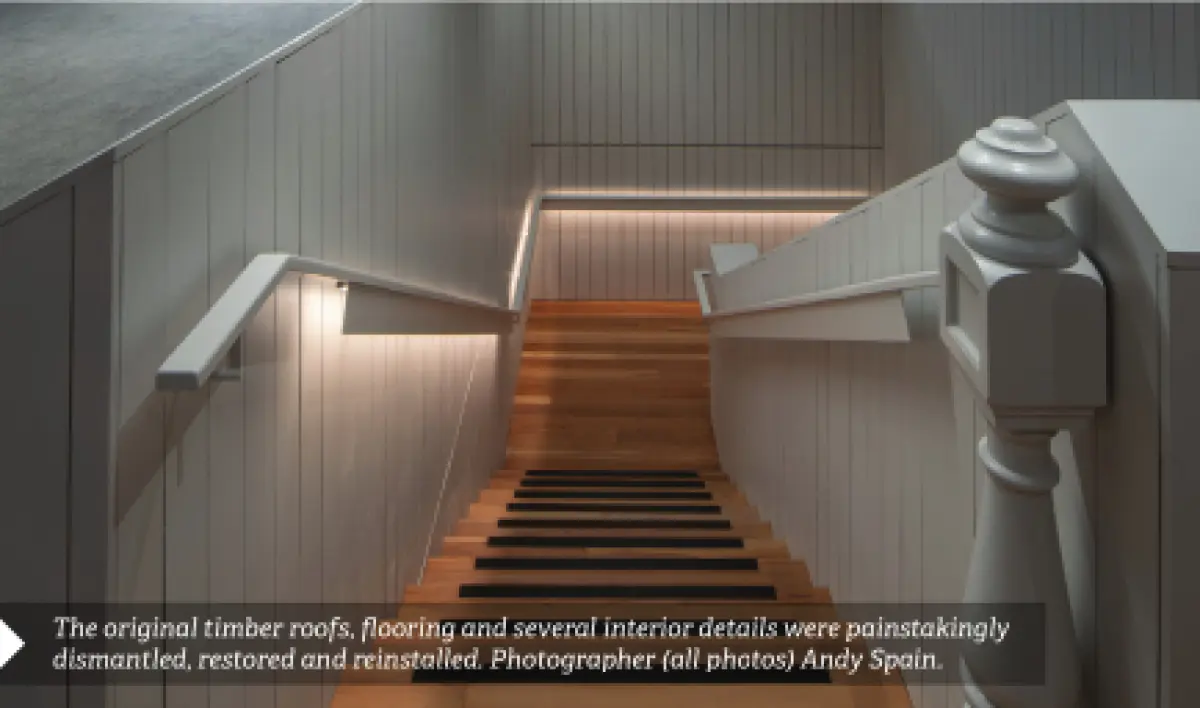
The original timber roof structures were painstakingly dismantled, restored and placed into storage before being reinstalled once construction on the Stewart Dawson’s corner site was complete.
The heritage restoration also reinstated several unique parapet elements from the three buildings’ original designs, including intricate stonework apothecary symbols in the Fletchers Building that reflected the building’s original use as a chemist.
The two towers
The larger and more contemporary elements of the project consist of two towers – a new steel-framed structure located behind the three heritage buildings on the Stewart Dawson’s corner site and a retrofit and extension of the existing 1980s-era concrete structure at 8 Willis Street.
‘From a construction point of view, the new tower on Stewart Dawson’s was relatively straightforward. The steel frame lends itself to achieving a contemporary seismic resilience level and allows for strengthening of the façade. While this was a challenge from a heritage perspective, it was a more straightforward engineering and construction task,’ says Stephen. ‘8 Willis Street was a much more significant challenge. We not only had to strengthen the concrete frame and significantly change the building envelope but also keep it seismically safe during the construction process.’
Compounding the seismic challenges on the 13,000 square metre project, contractors had to relocate the lift shafts to achieve a more efficient floor plate and create a new central atrium, add three new storeys and extend the main structure forward several metres to be flush with the street frontage and the heritage façade next door.
With one frame using concrete and the other using steel, the two towers have different seismic characteristics. A seismic joint between the two structures enables them to move independently without damaging one another during a seismic event.
Contemporary appeal
Despite their proximity, it was a deliberate decision to make the towers look different but visually related, each with their own distinct exterior designs and treatment of materials. The rationale was that two different buildings appear less overwhelming to the smaller heritage Stewart Dawson’s buildings than a single, large L-shaped building looming over the entire corner.
To achieve this, the glazed curtain walls on the outside face of the Stewart Dawson’s tower are darker in colour and used sloping fins, reflecting the steel crossbracing elements within the building. The Willis Street tower maintains the same general continuity but alternatively pushes the glass backwards and forwards to give it a distinct pattern on the street edge.
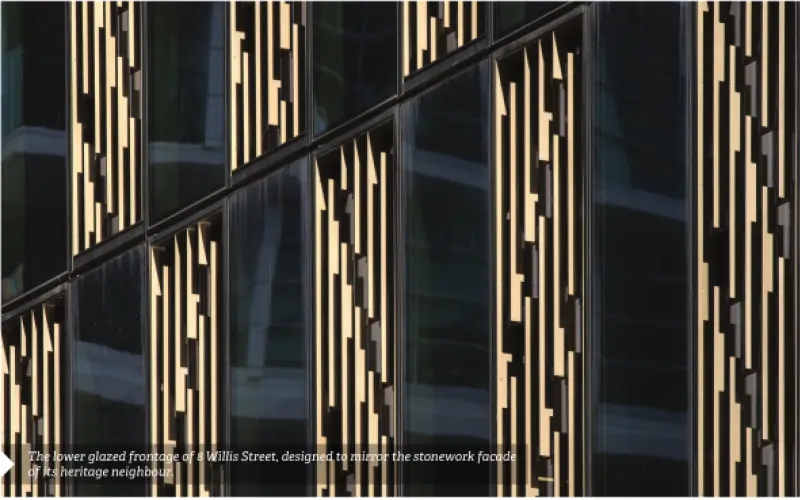
The glazed front wall of 8 Willis Street also changes at the height of the Stewart Dawson’s building’s heritage pediments. Down to street level, the glazed panels become smaller and employ a poutama tukutuku design, which mirrors the scale and rhythm of the heritage façade.
Impressive credentials
Throughout the project, a key consideration was attracting high-quality, long-term tenants. All three structures are designed to 130% of the new building standard (NBS) for seismic risk. 8 Willis Street has achieved the New Zealand Green Building Council’s World Excellence 6-star Green Star – Office Built V3 Certified and is targeting a 5-star NABERSNZ rating. It also was awarded a 6-star Green Star for Interiors rating earlier this year.
Both factors were instrumental in Tatauranga Aotearoa Stats NZ’s decision to lease the property after its previous headquarters Statistics House was badly damaged in the 2016 Kaikōura earthquake. It shares the new space with the Ministry for the Environment, with common reception and public facilities.
‘Architecturally, we wanted to create a contemporary flexible office environment, and the result is a fresh, draught-free work environment with great natural light and lovely views out over the city,’ says Stephen.
‘It’s done so the new development complements and treads lightly on the heritage elements and at the same time adds to and complements the street. We take a great deal of satisfaction from that.’