




Delivering affordable homes without compromising on quality remains one of Aotearoa New Zealand’s most persistent and complex challenges. In Build 205, BRANZ Chief Executive Claire Falck remarked on this tension, saying that, while affordability pressures dominate project delivery, quality often becomes a secondary consideration, addressed late, inconsistently or not at all.
In Aotearoa, quality encompasses structural durability, material resilience, occupant comfort, regulatory compliance and, increasingly, long-term performance and environmental sustainability. Yet
quality is not always treated as a measurable or co-managed project value. As Claire Falck pointed out, the system lacks mechanisms that can ensure affordability and quality are delivered together, not traded off against each other.
Managing affordability and quality together
Innovations in construction, off-site manufacturing, digital inspection tools and smarter consenting pathways reflect critical shifts already under way. They offer practical ways to lift quality while easing cost pressures, but we suggest they can be even more impactful when supported by a delivery framework that manages affordability and quality together throughout the project life cycle.
Together, target value delivery (TVD) with life cycle assessment (LCA) offer a practical way to translate early project aspirations into informed decisions that protect both budgets and long-term value. This does not depart from current efforts but is a way to amplify them, treating quality and affordability not as trade-offs but as shared, measurable targets.
Defining value early and delivering it
Addressing the quality-affordability tension requires a delivery system that makes both values explicit, measurable and non-negotiable across the project life cycle. TVD offers this – establishing a clear business case, what the client wants, what they can afford and what value the project must deliver across its lifespan. These targets are then steered not only during design but throughout construction, using collaborative, constraint-driven methods.
Cost ceilings are treated as commitments while value expectations – including quality, functionality and usability – are tracked and protected, reducing costs and ensuring acceptable net benefits over the life cycle of the asset.
TVD establishes co-defined performance targets and embeds them into real-time decision making to ensure quality is not left to interpretation or chance. It treats value defined by the client, which may include usability, environmental performance, ease of maintenance and even regulatory readiness. This framing is particularly relevant in the housing sector, where government agencies and public clients are increasingly expected to balance affordability with resilience, carbon reduction and life cycle durability and where developers and delivery partners are being asked to demonstrate alignment with these evolving expectations.
Making long-term value visible
A persistent difficulty in delivering quality is that many of its consequences emerge after construction in the form of maintenance needs, system failures or performance gaps that weren’t visible during handover. To deliver value that lasts, ways to anticipate these outcomes during delivery are needed.
The LCA methodology offers a structured way to do this. Traditionally used to measure environmental impacts, it also sheds light on material durability, maintenance needs and whole-of-life performance, helping teams avoid false economies and flagging where short-term savings can create long-term costs. When embedded in a TVD framework, LCA is a valuable decision support tool, helping teams compare options with clearer insight into downstream trade-offs.
While LCA is mostly associated with sustainability certifications like Green Star or Homestar, its principles can be applied simply for comparing material durability to anticipating maintenance demands without requiring full-scale modelling, making it useful for public sector clients who are expected to deliver affordability, performance and carbon accountability together. At the same time, LCA does not measure aspects of quality such as workmanship, usability or client satisfaction.
In TVD, quality is also tracked through proxies such as:
- inspection pass rates
- functional performance indicators
- alignment with user needs
- team-defined criteria for durability or maintainability.
These metrics are not about perfection – they are about keeping the team focused on what the client values and detecting drift early. Tools like LCA and performance proxies together help shift quality to a shared, trackable part of the delivery process.
A dashboard for value
One of the limitations in current project delivery is that cost, quality and value are tracked in isolation – if they’re tracked at all. There is often no single view that shows whether a project is drifting from what the client values.
Sometimes the most expensive quality failures never make it into formal reports. Instead, they show up as rework, programme pressure or systems that underperform well before their time. What is missing is a way to connect delivery decisions to long-term value.
One answer is a value delivery dashboard – a practical framework that integrates familiar tools (cost plans, quality benchmarks, life cycle assessments and performance trackers) into a single visual interface (Table 1). This brings together key delivery metrics, including affordability, durability, embodied carbon, maintenance forecasts and cost-value alignment, into a synthesised system.
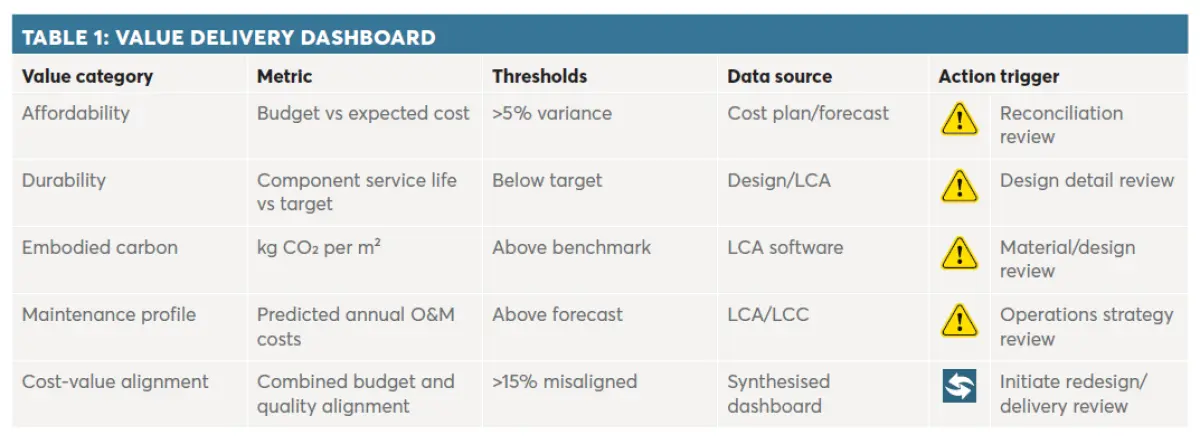
Rather than adding complexity, it draws from existing project control practices, linking them to questions such as these:
- Are we still on track to meet the agreed-upon definition of quality?
- Are budget and carbon metrics being traded off without visibility?
- Are operational outcomes or user needs being compromised for short-term gain?
Versions of this approach already exist in fragmented form as carbon reporting tools, cost-control sheets, earned-value models and life cycle forecasts. The opportunity is to bring them together in a delivery-facing system that enables early intervention when cost, constructability or quality begin diverging.
Moving beyond trade-offs
Improving quality does not have to make housing unaffordable. In fact, fixing quality failures after the fact often costs more than getting it right the first time. TVD and LCA together create a feedback loop linking design intent, delivery choices and operational performance. They support smarter decisions and reduce the need for reactive fixes, aligning with evolving policy expectations and delivery culture.
The TVD/LCA framework is not about more layers of reporting but giving delivery teams a practical system for protecting value, from the first decision to final handover.
Kāinga Ora’s use of collaborative project delivery reinforces the feasibility of this approach at scale. Broader uptake depends not only on tools like TVD and LCA but also on shifting delivery culture towards shared accountability and long-term thinking.
Integrated, outcome-aware delivery is no longer a frontier – it’s a necessity.