

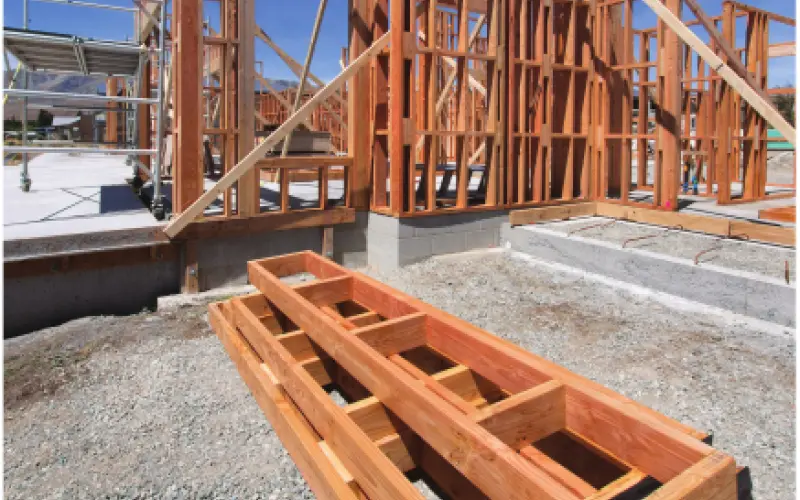


Some architectural practices in Aotearoa New Zealand use 140 mm framing in the external walls of all the new homes they work on. The most obvious benefit is that a deeper wall cavity – compared to 90 mm framing – allows space for higher-performing insulation with a wider range of insulation materials. It is easier to comply with or exceed the requirements in the schedule method of H1/AS1 5th edition amendment 1, which set a minimum of R2.0 for unheated walls in all climate zones. Homeowners enjoy a warmer living environment and potentially lower heating costs.
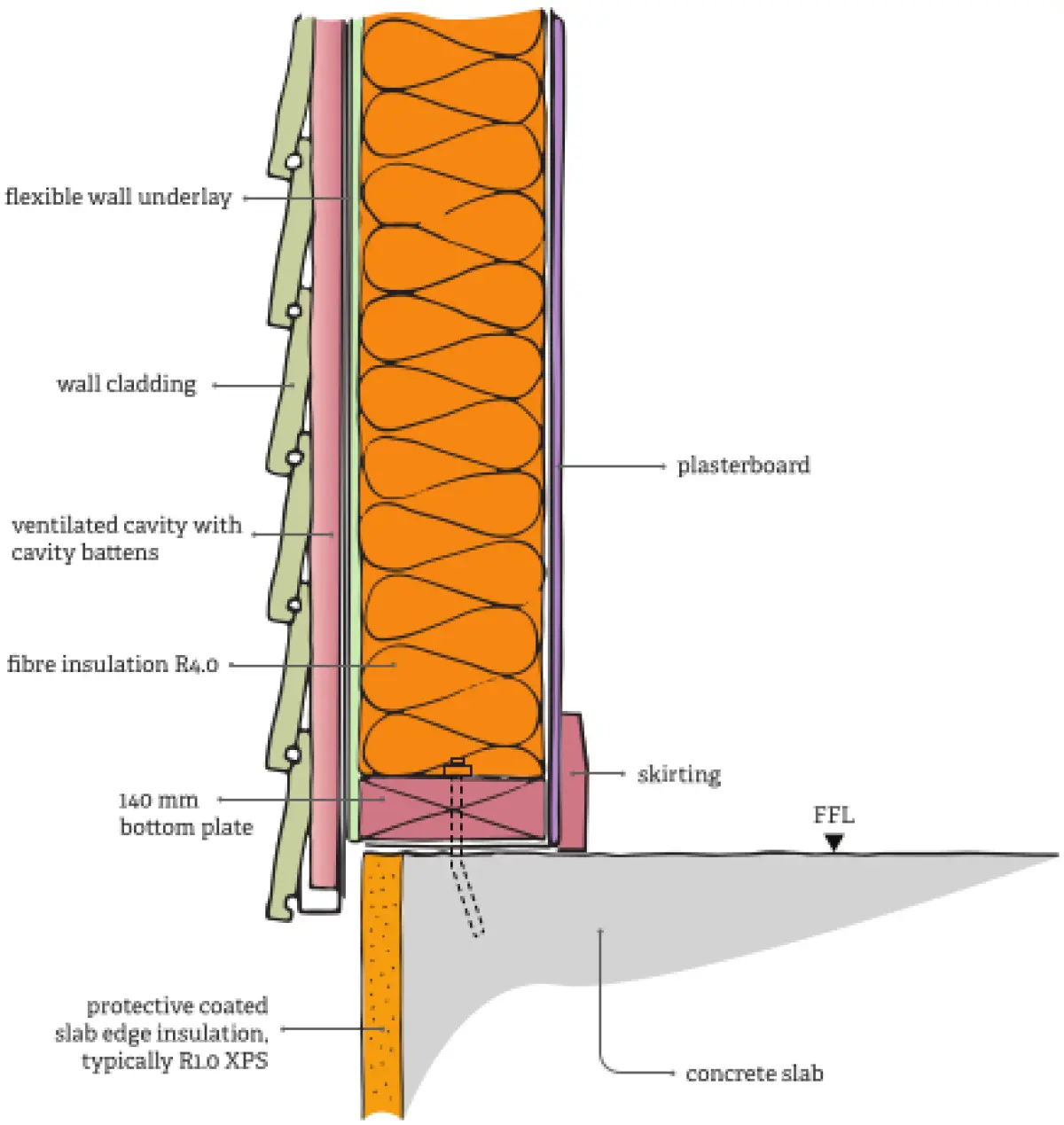
A second insulation-related benefit is that the extended overhang possible with a 140 mm bottom plate makes it easier to specify insulation around the vertical slab edge (see Figure 1). BRANZ research has found that vertical slab edge insulation can greatly improve thermal performance. The tables in Appendix F of H1/AS1 5th edition amendment 1 (and Appendix E of H1/AS1 6th edition) give construction R-values for a range of slab floors incorporating R1.0 vertical slab edge insulation.
Increasing the construction R-value in external walls beyond the Building Code minimum has another specific benefit at the design stage of new housing – it opens the possibility for trade-offs with insulation in other building elements when using the calculation or modelling methods to demonstrate H1 compliance.
There is also the practical advantage on site that having a 140 mm bottom plate makes it easier for builders to install anchor fixings to concrete slabs at the recommended distance from the slab edge. Installing bolts or anchors in a 90 mm bottom plate at slab edges can sometimes be difficult. If there is the recommended overhang over the slab edge of 6 mm (the minimum distance regarded as good practice), it may not be easy to locate the fixings with minimal tolerances when proprietary fixings have minimum edge distance of 50 mm. Using 140 mm framing removes the difficulty.
The 90 mm and 140 mm Code differences
NZS 3604:2011 Timber-framed buildings, the main standard for structural requirements in houses, sets out requirements and limitations for 90 mm and 140 mm wall framing. These are some key differences from Table 8.2 of the standard:
- With 140 mm framing, stud heights can be increased over 90 mm framing at the same centres.
- 140 mm studs can be installed at wider spaces than 90 mm studs. This can help to reduce thermal bridging and improve thermal performance. Architects and designers will need to ensure that lining and cladding thicknesses are appropriate for the wider spacing.
- 140 x 45 mm framing may be substituted for 90 x 90 mm. This means that, where the tables require a 90 x 90 mm stud, a 140 x 45 mm stud can be used. The reverse is not true – where a 140 x 45 mm stud is required in the tables, it cannot be substituted with a 90 x 90 mm stud. Any substitution must be with a greater depth stud.
140 mm framing vs other options
Specifying 140 mm rather than 90 mm exterior wall framing is not the only way to achieve higher thermal performance in external walls. Another option includes adding a secondary insulation layer to either 90 mm or 140 mm exterior wall framing.
A secondary insulation layer can give a significant improvement in thermal performance – potentially larger than the improvement from just using 140 mm over 90 mm framing. The R-values achieved can be found using the tables in the BRANZ House insulation guide 6th edition. However, using a secondary insulation layer obviously requires more labour and takes longer to construct.
If this cavity is on the inside of the wall, a plasterboard wall lining can no longer serve as bracing – another bracing element will be required between the primary and secondary insulation cavities. Plasterboard bracing can still be used as bracing if the secondary insulation cavity is on the outside of the structural wall framing.
Other types of construction materials such as structural insulated panels (SIPs) can also be used to achieve better thermal performance in exterior walls.
An investment with a decades-long return
All the options for improving the thermal performance of external walls will add to the total build cost, but this will be offset during the service life of the house by a more comfortable living environment for the occupants and potentially reduced operating costs, particularly for space heating. It is cheaper and easier to design and construct walls with higher thermal performance at the start (for example, by using 140 mm exterior wall framing) than it is to retrofit walls later.